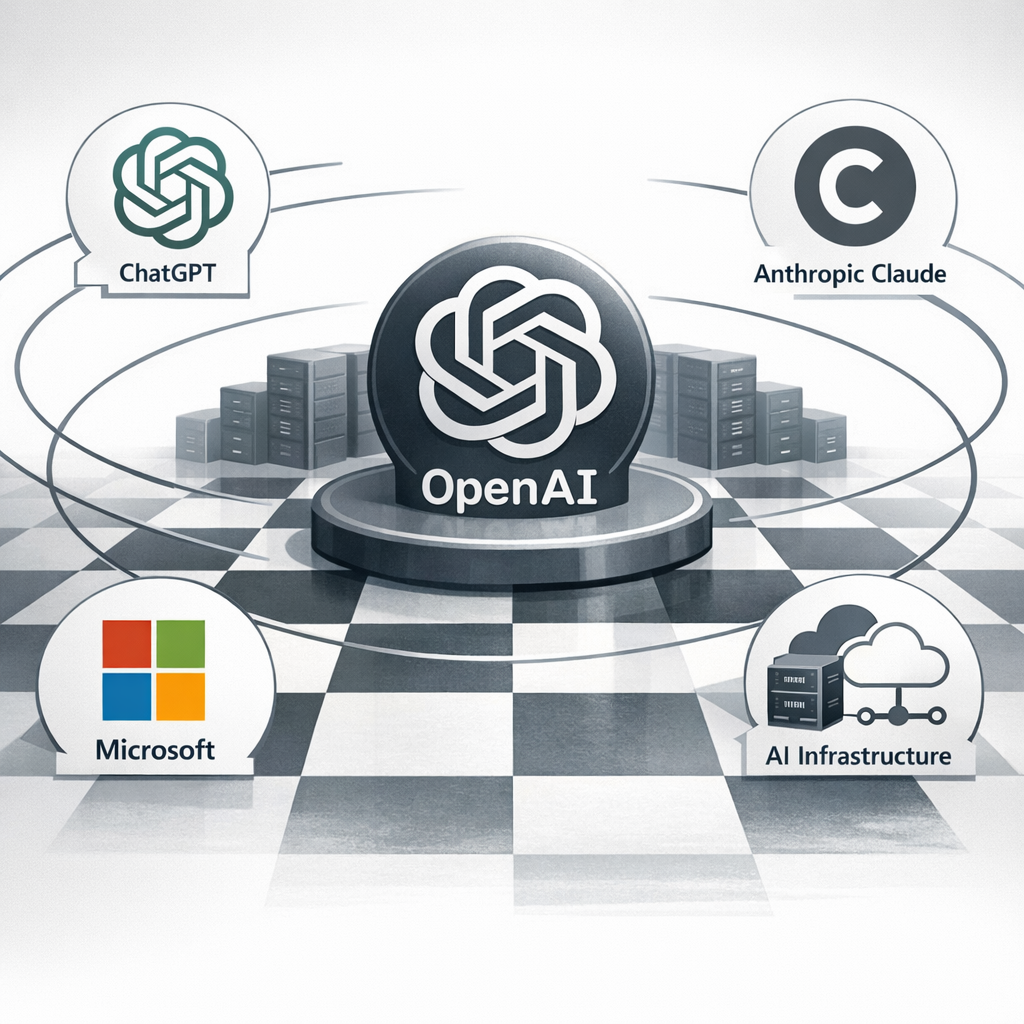
OpenAI Is No Longer Just a Model Company
OpenAI strategy 10179 is at the center of this update. ChatGPT made OpenAI famous. The harder task now is turning that fame into lasting power in a market where Anthropic, Microsoft, and infrastructure costs all matter more.
OpenAI’s biggest challenge is not relevance. It is conversion. The company already won the first race: make AI feel real to millions of people. The next race is harder. It has to turn ChatGPT’s cultural dominance into strategic control, and those are not the same thing.
OpenAI’s real problem is that attention is not a moat
Fact: ChatGPT remains the product most closely associated with generative AI, and Sam Altman is one of the most influential executives in the sector.
Interpretation: That influence is real, but it can also be misleading. A company can dominate the conversation without yet proving it can dominate the economics. In AI, the gap between popularity and defensibility is wide.
Argument: OpenAI now has to justify its position on more than novelty. It has to show it can keep users, developers, and partners locked in while also absorbing the cost of staying at the frontier.
Claude is forcing the market to ask better questions
Fact: Anthropic and Claude have become serious competitors in the AI assistant market.
Interpretation: That matters because competition is no longer about whether another chatbot exists. It is about whether another company can offer a different mix of trust, reliability, and enterprise credibility.
Argument: Anthropic does not need to beat OpenAI everywhere to matter. It only needs to make the market less forgiving. Once that happens, OpenAI can no longer rely on being the obvious default.
The compute bill is part of the strategy, not a footnote
Fact: OpenAI’s ambitions depend on access to chips, capital, and infrastructure.
Interpretation: That dependence changes the company’s posture. A model company is one thing. A company that must continuously fund and feed a huge compute machine is something else entirely.
Argument: The AI race is increasingly a contest over who can sustain scale. That favors companies with strong partners, deep pockets, and a product that keeps generating demand. OpenAI has pieces of that formula. It does not have a permanent solution.
The counterpoint: OpenAI still sets the pace
Fact: OpenAI remains the benchmark many rivals define themselves against.
Interpretation: That is not a small advantage. In platform markets, the first company to become synonymous with the category often keeps a structural edge longer than critics expect.
Argument: It is possible that the skepticism around OpenAI is premature. ChatGPT’s brand power is real, and brand power can become distribution power. OpenAI still looks like the company with the strongest claim on the center of the market.
What this means for the AI race
The AI race is shifting from model novelty to platform control. That shift is uncomfortable for OpenAI because it invites scrutiny on trust, economics, and governance at the same time. But it also confirms why OpenAI matters so much: it is the reference point for the whole industry.
Editorial conclusion: OpenAI already proved that AI could become mainstream. Now it has to prove that mainstream attention can be turned into durable power. That is a much harder test, and one the company cannot solve with another splashy launch alone.
Business analysis, not investment advice.
Related coverage: AI Chronicle analysis and updates.
Sources and further reading
- http://OpenAI%20public%20product%20announcements%20and%20official%20materials
- https://openai.com/news/
- https://www.anthropic.com/news

 How AI Automation Is Silently Redefining the Middle Class and the Future of Work
 Sam Altman’s OpenAI: Redefining the Power Dynamics of the AI Race
 How Sam Altman’s Quiet Rise Is Reshaping AI Power and Governance