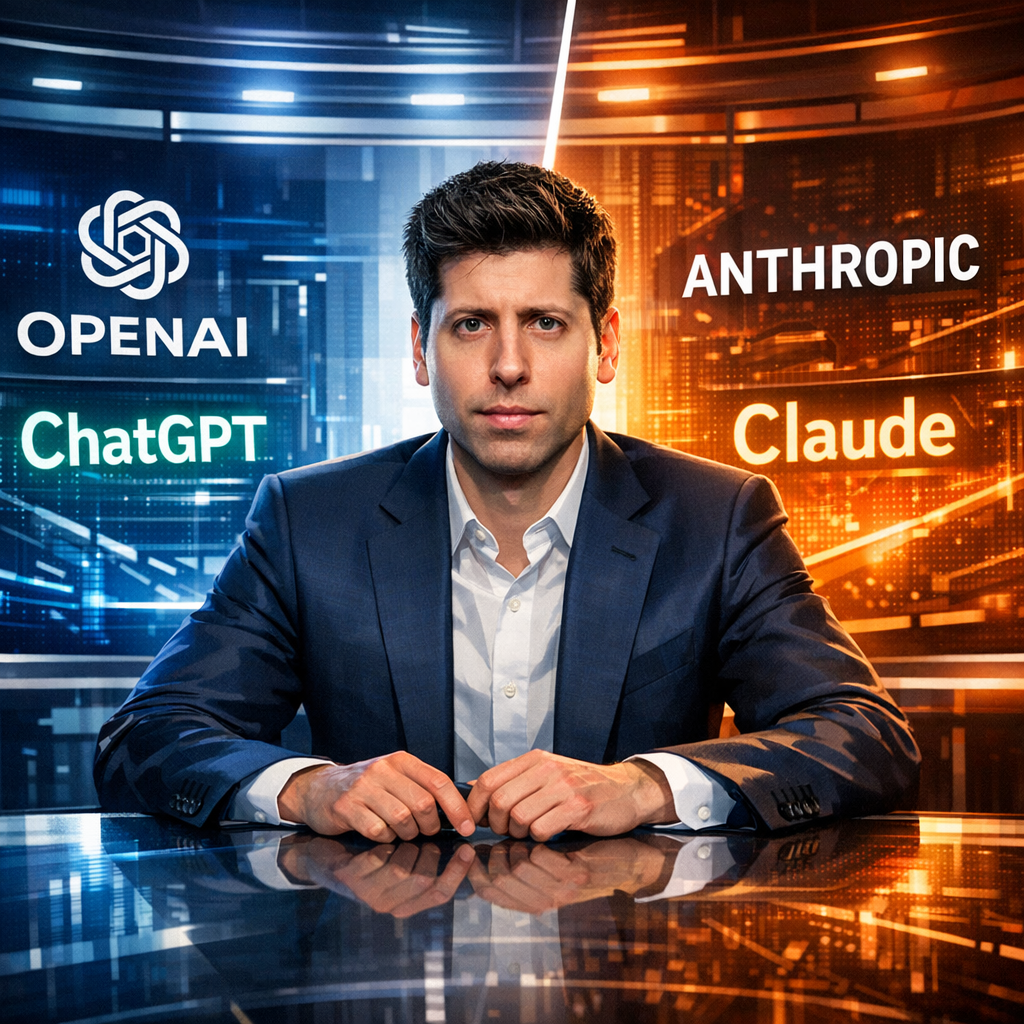
OpenAI Is No Longer Just ChatGPT — and That Is the Problem
OpenAI ChatGPT Sam Altman tension is at the center of this update. Subtitle: Sam Altman built a category leader, but the company’s power now comes with a tension it cannot fully escape.
ChatGPT made OpenAI famous. Sam Altman made it unavoidable. Those are not the same thing, and the gap between them is where the real story lives.
OpenAI is no longer just a lab shipping a product. It is a company, a platform, and a founder-driven institution that now sits at the center of the AI race. That is a powerful position. It is also a fragile one.
ChatGPT made OpenAI the default — and the default is now the burden
Facts: OpenAI created ChatGPT and turned it into the most visible consumer AI product in the market. The chatbot became the public face of generative AI far beyond the developer audience that once defined the space.
Interpretation: That success gave OpenAI something rare: habit. When a product becomes the default way people experience a technology, the company behind it gains enormous leverage over attention, distribution, and mindshare.
Argument: But defaults attract expectations that are harder to satisfy than early enthusiasm. Every product change, policy shift, model update, and outage becomes a referendum on OpenAI itself, not just on ChatGPT. The company is now judged as infrastructure, consumer app, and strategic power center at once.
Sam Altman is not just the CEO; he is part of the product
Facts: Sam Altman is OpenAI’s chief executive and one of the most visible figures in AI. His public presence is inseparable from OpenAI’s market position.
Interpretation: That visibility helps OpenAI. It creates narrative control, keeps the company at the center of the conversation, and reinforces the sense that OpenAI is the place where the industry’s most important decisions happen.
Argument: The downside is obvious: when a company’s identity is fused to its founder, the founder becomes a strategic variable. The market starts reading product strategy through personality, governance through drama, and long-term ambition through whatever Altman says or implies next. That is not just media theater. It affects trust.
Anthropic and Claude are betting that restraint can be a strategy
Facts: Anthropic and its Claude models have emerged as a serious competitor, especially for users and companies that want a more measured, enterprise-friendly alternative. Anthropic has also leaned harder into safety as part of its positioning.
Interpretation: Claude’s value is not that it wins every consumer headline. Its value is that it gives the market a comparison point. Against OpenAI’s scale and visibility, Anthropic can sell discipline, consistency, and a more cautious posture.
Argument: That makes the rivalry deeper than model quality. OpenAI is selling breadth and momentum. Anthropic is selling restraint and trust. One is trying to be everywhere. The other is trying to be credible in the places that matter most for adoption.
The real contest is over trust, not just capability
Facts: OpenAI and Anthropic both compete for users, developers, and enterprise buyers. Both also depend on outside compute, capital, and distribution partnerships to scale.
Interpretation: In a market this expensive to build, technical performance alone is not enough. Buyers are asking which company will be stable, which one will govern its models responsibly, and which one will remain aligned with their needs as the market matures.
Argument: That is why OpenAI’s tension matters. The company has become powerful enough to set expectations for the category, but that also means its trust premium is constantly being tested. Anthropic does not need to beat OpenAI everywhere. It only needs enough customers to decide that caution is worth paying for.
What changes next depends on whether scale or credibility wins
Counterpoint: OpenAI’s critics often overstate the problem. The company’s combination of product reach and founder visibility may be exactly why it has outpaced rivals. In AI, speed and distribution are not side issues. They are the game.
Response: That is true — up to a point. The same qualities that make OpenAI dominant also make it more exposed to backlash if users, developers, or partners start believing that the company’s priorities are drifting away from reliability or openness.
Conclusion: The AI race is entering a phase where the winner will not just be the company with the smartest model. It will be the company that can scale power without making itself look untrustworthy. OpenAI has the lead. The question is whether its structure can survive the weight of that lead.
Sources consulted: OpenAI official materials, Anthropic official materials, Microsoft investor disclosures, and reputable market reporting on OpenAI, ChatGPT, Sam Altman, Anthropic, and Claude.
Related coverage: AI Chronicle analysis and updates.
Sources and further reading
- http://OpenAI%20official%20website%20and%20product%20documentation
- https://openai.com/news/
- https://www.anthropic.com/news

Related Articles
 Why AI Power Is Concentrating Faster Than Wealth and What It Means for Society
 A Era do Emprego Está a Acabar? Como a Automação e a IA Redefinem o Futuro do Trabalho
 Why OpenAI’s Biggest Challenge Isn’t Innovation but Trust in AI Governance
 Why Sam Altman’s Leadership Defines the New Power Dynamics in Artificial Intelligence