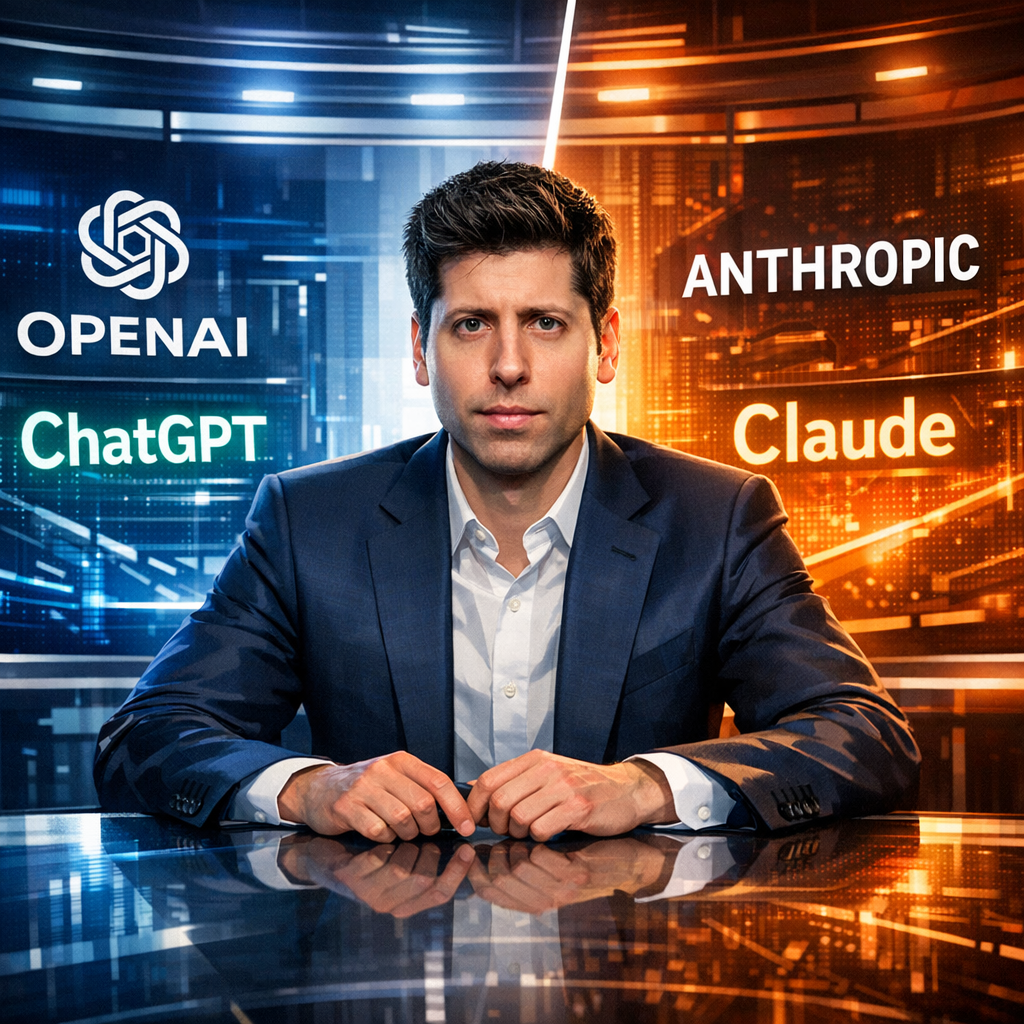
OpenAI Is Becoming More Than a ChatGPT Company
OpenAI strategy 10033 is at the center of this update. Subtitle: The real story is not chatbot popularity. It is how OpenAI is turning product demand, partner dependence, and trust into leverage.
It is tempting to explain OpenAI with a simple line: ChatGPT won, so OpenAI won. That is the easy story, and it is incomplete.
The more important truth is that OpenAI is no longer just a model maker with a breakout product. It is becoming a system-level company whose influence now extends across consumer habits, enterprise adoption, infrastructure demand, and partner strategy.
ChatGPT is the headline. OpenAI’s leverage is the stack underneath.
Facts: ChatGPT remains the company’s signature product and the most visible entry point into OpenAI’s ecosystem. Microsoft remains a major strategic partner. Anthropic’s Claude has become a serious rival, especially in enterprise positioning.
Interpretation: Those facts point to a company whose real strength is not a single interface, but the ability to make that interface the front door to a wider AI stack.
Argument: In a market where model quality can be copied faster than distribution, OpenAI’s advantage is that it has already turned attention into habit. That is harder to dislodge than a benchmark lead.
Anthropic proves OpenAI is strong, not untouchable
Claude is the best reminder that OpenAI does not own the future by default. Anthropic has built a credible alternative by emphasizing trust, enterprise use, and a different brand of discipline.
That is the strongest case against the idea that OpenAI is simply pulling away from the field. If enterprises, developers, or regulators decide they prefer a different posture, OpenAI’s dominance becomes less certain.
But uncertainty is not the same as weakness. The fact that Anthropic has to define itself against OpenAI is itself evidence of OpenAI’s centrality.
Microsoft and the infrastructure layer make OpenAI harder to ignore
Facts: Microsoft’s investor materials and earnings commentary continue to frame AI as a core part of its product strategy. OpenAI sits inside that broader commercial system.
Interpretation: That relationship matters because it shows OpenAI is not merely chasing product adoption. It is embedded in the broader machinery of AI distribution.
Argument: The companies that matter most in AI will not be the ones with the loudest launches. They will be the ones that can sustain demand, absorb compute costs, and keep their partners aligned as the market matures.
The real risk is overextension, not irrelevance
There is a serious counterpoint here. OpenAI’s visibility creates pressure. Its governance, expectations, and ambitions are all under scrutiny. It must keep shipping while also defending its position against rivals that can specialize in trust, price, or open distribution.
That is a real risk. OpenAI could try to do too much at once: consumer brand, enterprise platform, developer ecosystem, and strategic center of gravity. Companies often break when they confuse reach with control.
Still, the market is telling a different story. OpenAI is becoming the company everyone measures themselves against. In AI, that is not a side effect. It is the point.
What OpenAI’s rise says about the AI race
The AI race is no longer a clean contest between research breakthroughs. It is a fight over distribution, infrastructure, and trust.
OpenAI’s evolution suggests the winners will be the companies that can turn technical capability into a durable system of dependence. ChatGPT opened the door. The larger strategy is everything behind it.
Conclusion: OpenAI is not just changing how people use AI. It is showing the rest of the industry what power in AI now looks like.
Sources consulted
- OpenAI official product announcements and company materials
- Microsoft investor materials and earnings commentary
- Anthropic official Claude materials and enterprise positioning
- Reputable market reporting on OpenAI, Microsoft, and Anthropic competitive dynamics
Related coverage: AI Chronicle analysis and updates.
Sources and further reading
- http://OpenAI%20official%20product%20pages,%20announcements,%20and%20company%20materials
- https://openai.com/news/
- https://www.anthropic.com/news

 The Automation Revolution: How AI Is Quietly Killing Middle-Class Jobs and What We’re Ignoring
 Is AI Automation Silently Killing the Creative Professions?
 How AI Power Concentration Threatens Innovation and Society
 Why OpenAI’s Quest for AI Power Is Triggering a Trust Crisis in Tech