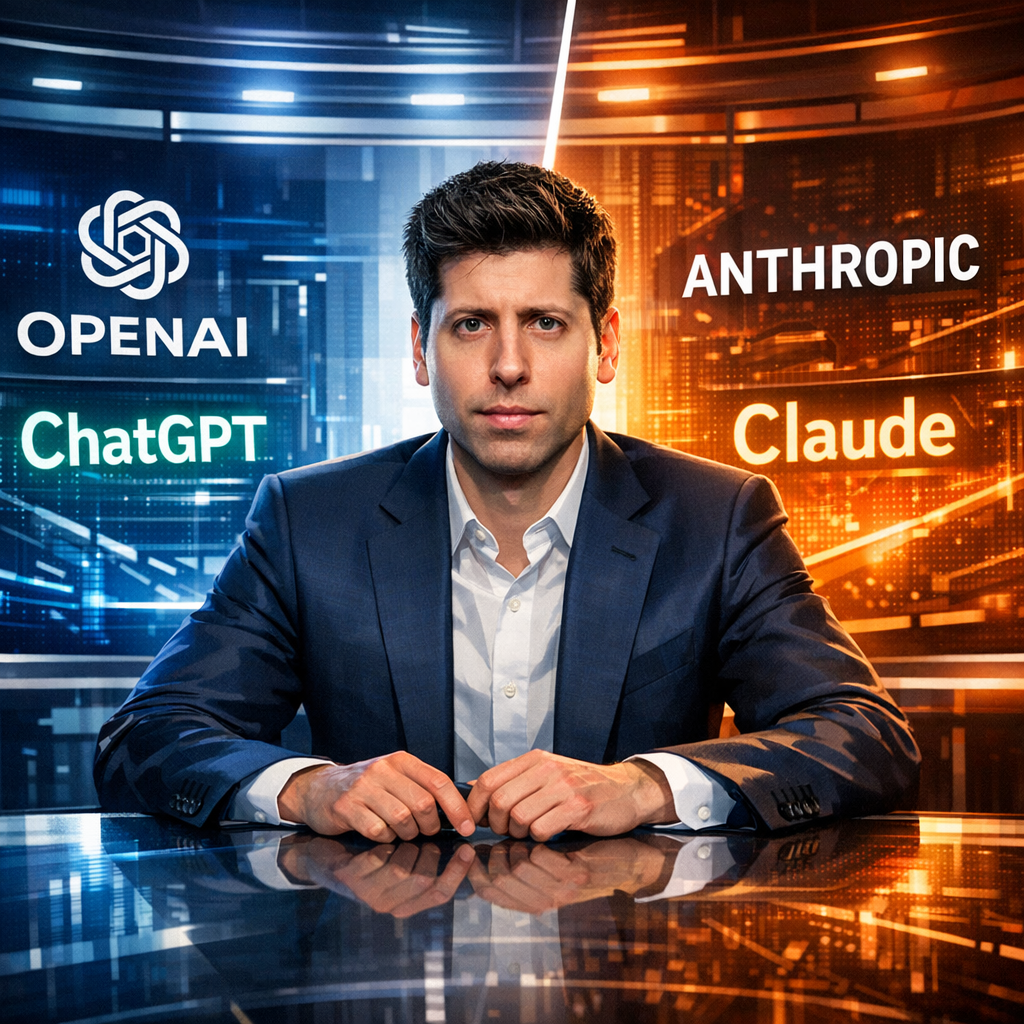
OpenAI Is Not Just Winning the AI Race — It Is Redefining What Winning Means
OpenAI strategy 9857 is at the center of this update. ChatGPT made OpenAI famous. The harder question is whether Sam Altman’s company is becoming too central to the future of AI to be treated like a normal startup.
OpenAI’s most important achievement is not that it built a popular chatbot. It is that it has become a central layer in AI distribution, perception, and competition. That makes the company more influential than most of its rivals, but also more exposed to trust and governance failures.
OpenAI’s real advantage is not the model — it is the position
The facts point in one direction: ChatGPT turned OpenAI into a household name, and Microsoft’s partnership gave it access to a much larger distribution and cloud ecosystem. OpenAI is no longer just a research story or a product story. It is a company that sits in the middle of how consumers and businesses now encounter AI.
That is the strategic change worth focusing on. In an industry where compute is expensive, product cycles are fast, and attention is scarce, OpenAI’s advantage is not just technical capability. It is habit. It is brand. It is the ability to shape what “AI” means before rivals even get to frame the conversation.
Why Anthropic and Claude keep running into OpenAI’s shadow
Anthropic has built a credible competing narrative around Claude, especially for enterprise users who want a more measured pitch. But that is the point: rivals are increasingly defined in relation to OpenAI. They are not just selling models. They are selling an alternative to OpenAI’s scale, pace, and style of ambition.
Sam Altman’s role matters here too. He has become more than a CEO with a good demo. He is now one of the faces of the industry’s center of gravity. That kind of visibility can be a competitive advantage because it attracts users, partners, and attention. It can also harden expectations around OpenAI in a way that makes every misstep bigger than it would be for a quieter competitor.
The trust problem is not separate from the business model
The strongest objection to this thesis is that OpenAI’s dominance may be overstated. Popularity is not the same as durable control. Visibility is not the same as resilience. And the more central OpenAI becomes, the more every governance question matters.
That is why trust is not a public-relations issue here. It is the business issue. If users, enterprises, regulators, or partners conclude that OpenAI’s incentives are too opaque, then scale becomes a burden rather than a moat. In that scenario, the company’s reach would not protect it; it would expose it.
What OpenAI says about the next phase of the AI race
The AI race is moving away from the idea that the best model automatically wins. OpenAI’s rise suggests that the real contest is about who can combine model quality, distribution, product habit, and ecosystem leverage. That is a more political competition than a technical one.
It also means the market should stop treating OpenAI as if it were only a startup with a strong chatbot. It is becoming infrastructure in the broader sense: a layer people rely on, debate, and organize around. That is why it fascinates supporters and alarms critics at the same time.
Conclusion: OpenAI should be understood as a company turning influence into infrastructure. ChatGPT was the breakthrough. The real story is what OpenAI is becoming after the breakthrough.
Sources consulted: OpenAI product announcements and company materials; Microsoft investor materials and earnings commentary on AI partnerships and Copilot; Anthropic company materials and Claude product information; reputable market reporting on OpenAI, Anthropic, and the AI platform competition.
Related coverage: AI Chronicle analysis and updates.
Sources and further reading
- http://OpenAI%20product%20announcements%20and%20company%20materials
- https://openai.com/news/
- https://www.anthropic.com/news

Related Articles
 How AI CEOs Are Quietly Rewriting Power: The Untold Story of Control and Influence
 Why AI Trust Is the Real Battle Shaping the Future of Artificial Intelligence
 How AI Power Concentration Threatens Innovation and Democracy in the Age of NVIDIA and OpenAI
 Why Sam Altman’s OpenAI Faces Its Biggest Challenge: Trust in an AI-Powered World