Claude’s voice mode is moving up the model stack
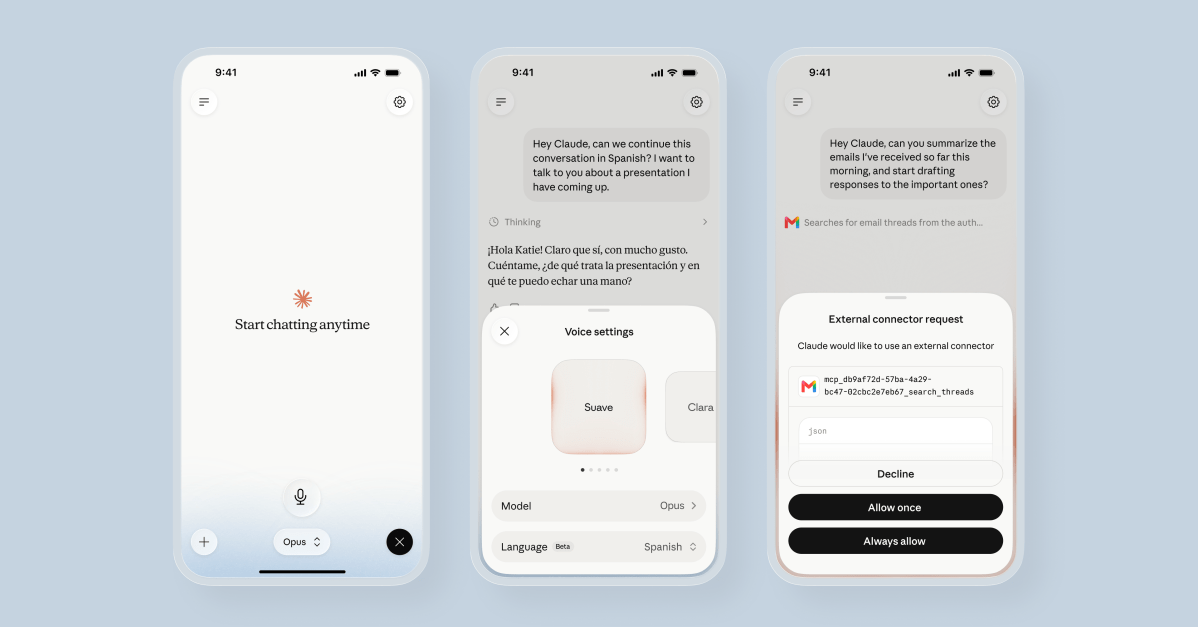
Claude voice mode analysis is at the center of this update. Anthropic is widening Claude voice mode from Haiku to Opus and Sonnet, and that is the real story behind the update. The company is no longer treating voice as a lightweight feature for fast replies. It is treating voice as a front end for more capable models that can handle longer, messier, more work-like conversations.
The change also extends Claude into apps such as Gmail, Slack, and Canva, which turns the feature into something closer to a workplace interface than a consumer demo.
Why Anthropic is pushing Claude beyond quick answers
According to the source, Anthropic launched voice mode with speed in mind. Haiku fit that job because it kept conversations quick. But the company says users quickly started using voice for “real business problems,” and that exposed the limits of a smaller model.
That is a useful clue about product-market fit. Anthropic appears to be learning that users do not just want a voice that responds fast. They want a voice that can stay useful when the task gets complicated.
What this says about OpenAI, ChatGPT, and Sam Altman’s lane
OpenAI and ChatGPT remain the reference point for mainstream AI assistants, which is why this update matters beyond Anthropic. If ChatGPT helped define what a general-purpose assistant looks like, Claude’s new voice strategy shows a different way to compete: not by imitating the same consumer chat experience, but by making the assistant more embedded in work.
That distinction matters in the rivalry between Sam Altman’s OpenAI and Anthropic. One side is still associated with the broad, default assistant people think of first. The other is trying to prove that a more enterprise-shaped assistant can be just as sticky, especially when it reaches into tools people already use all day.
The real contest is over where AI lives in the workday
The strategic split is not just about model names. It is about the role each company wants its product to play. ChatGPT is still the clearest symbol of the consumer AI assistant era. Claude’s move suggests Anthropic wants to own the “assistant inside your workflow” category.
If that works, the stakes are significant: voice becomes less about novelty and more about control of the interface layer. That is where AI products can become habits, and habits can become revenue, distribution, and developer lock-in.
What to watch as the Claude versus ChatGPT race evolves
The key question is whether Anthropic can make voice mode feel indispensable inside business software, not just impressive in a demo. Watch for whether users actually shift more serious work into Claude voice, and whether the integrations with Gmail, Slack, and Canva deepen over time.
Also watch OpenAI. If Anthropic is signaling that voice should be a serious workplace tool, ChatGPT may need to answer not just with better conversation, but with tighter workflow integration of its own.
Sources: The Verge’s report on Claude voice mode expanding to Opus and Sonnet, plus Anthropic’s blog post referenced in that report.
Related coverage: AI Chronicle analysis and updates.
Sources and further reading
- http://Anthropic%20blog%20post%20referenced%20in%20the%20source%20excerpt
- https://openai.com/news/
- https://www.anthropic.com/news

Related Articles
 Physical AI Conference to Spotlight Robotics and Autonomous AI Advancements in San Jose
 Google Faces Backlash as Gmail Uses User Emails to Train AI Models by Default
 Researchers Clarify Definition of World Models, Excluding Text-to-Video Generators
 Converge Bio Secures $25 Million to Advance AI-Driven Drug Discovery