OpenAI’s Real Rival Is the Company It Has Become
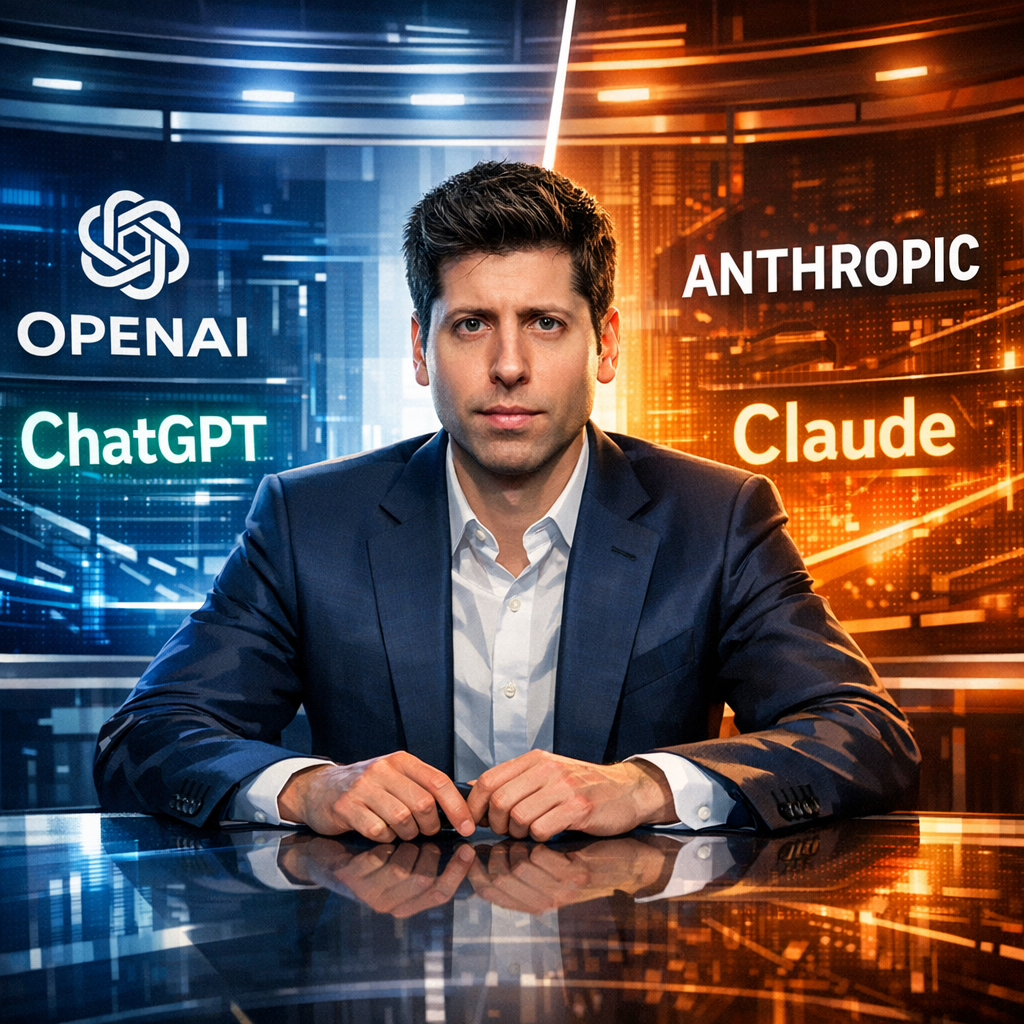
OpenAI ChatGPT rivalry 9519 is at the center of this update. ChatGPT made OpenAI famous. Sam Altman made it powerful. Anthropic shows what a different AI strategy looks like.
OpenAI’s most important rivalry is not only with Anthropic’s Claude. It is with the identity it has built for itself: part product company, part research lab, part market-making institution, and part founder-driven media force. That combination has helped OpenAI dominate the conversation. It has also created a tension that may define the next stage of the AI race.
ChatGPT Is the Product, but OpenAI Is the Power Structure
Facts: ChatGPT is OpenAI’s flagship consumer product, and Sam Altman is the company’s chief executive and public face. Anthropic’s Claude is one of the clearest rivals in assistant-style AI.
Interpretation: OpenAI’s advantage is not just model quality. It is the way ChatGPT collapsed technical progress into a consumer habit, then turned that habit into strategic leverage. Once that happened, OpenAI stopped looking like a lab with a chatbot and started looking like a company trying to own the front door to AI.
Argument: That is why the company’s internal tension matters. The more ChatGPT becomes synonymous with OpenAI, the harder it is to distinguish product success from institutional power. In AI, that distinction matters because the winner is not simply the best model builder. It is the company that can control access, defaults, and developer expectations.
Anthropic’s Claude Is the Cleanest Contrast OpenAI Has
Facts: Anthropic positions Claude around safety, enterprise usefulness, and a more restrained public posture.
Interpretation: Claude’s significance is not that it has already replaced ChatGPT. It is that it offers a different theory of trust. Anthropic is trying to prove that an AI company can win serious customers without turning every launch into a cultural event.
Argument: That contrast is useful because it exposes OpenAI’s vulnerability. OpenAI can dominate attention, but attention is not the same thing as durable confidence. If AI becomes infrastructure, buyers will care less about spectacle and more about consistency, governance, and product boundaries.
Sam Altman Amplifies OpenAI — and Concentrates the Scrutiny
Facts: Altman is one of the most visible executives in AI and a central figure in OpenAI’s rise.
Interpretation: His visibility is strategic. It helps OpenAI shape the narrative, attract partners, and stay at the center of the market’s attention. But it also turns every OpenAI decision into a referendum on his judgment and influence.
Argument: That is the hidden cost of founder-led AI power. The same force that makes a company hard to ignore can make it harder to trust. In a sector where model capability is converging faster than public confidence, leadership style becomes part of the product.
What Changes Next for Users and Developers
Facts: The AI race is increasingly tied to distribution, infrastructure, and developer ecosystems, not just benchmark performance.
Interpretation: Users will feel this as a fight over which assistant becomes the default interface. Developers will feel it as a fight over which platform is easiest to build on, integrate with, and trust over time.
Argument: If OpenAI keeps winning, the industry may organize around a small number of AI gatekeepers. If Anthropic gains ground, it could force the market to reward restraint and clearer product boundaries. Either outcome changes the economics of AI adoption.
The Stakes Are Bigger Than One Brand
Counterpoint: OpenAI’s scale is still its strongest asset. ChatGPT already has the brand recognition and usage habit that rivals have to chase. Altman’s prominence is not automatically a weakness; in a crowded market, it is a distribution engine.
Conclusion: But scale does not erase the tension. It intensifies it. OpenAI is now trying to be both the company everyone uses and the company everyone watches. Those are not the same thing. The AI race will reward the firms that can reconcile that gap without letting power outrun trust.
Related coverage: AI Chronicle analysis and updates.
Sources and further reading
- http://OpenAI%20official%20product%20and%20policy%20materials
- https://openai.com/news/
- https://www.anthropic.com/news

Related Articles
 # TITLE: How AI Discrimination Threatens to Widen Socioeconomic Inequalities
 How NVIDIA’s AI Monopoly Is Reshaping Power and Innovation in Artificial Intelligence
- # TITLE: How AI Is Emerging as a Political Weapon in Modern Governance
 A Era do Emprego Está a Acabar? Como a Automação e a IA Estão Redefinindo o Trabalho