
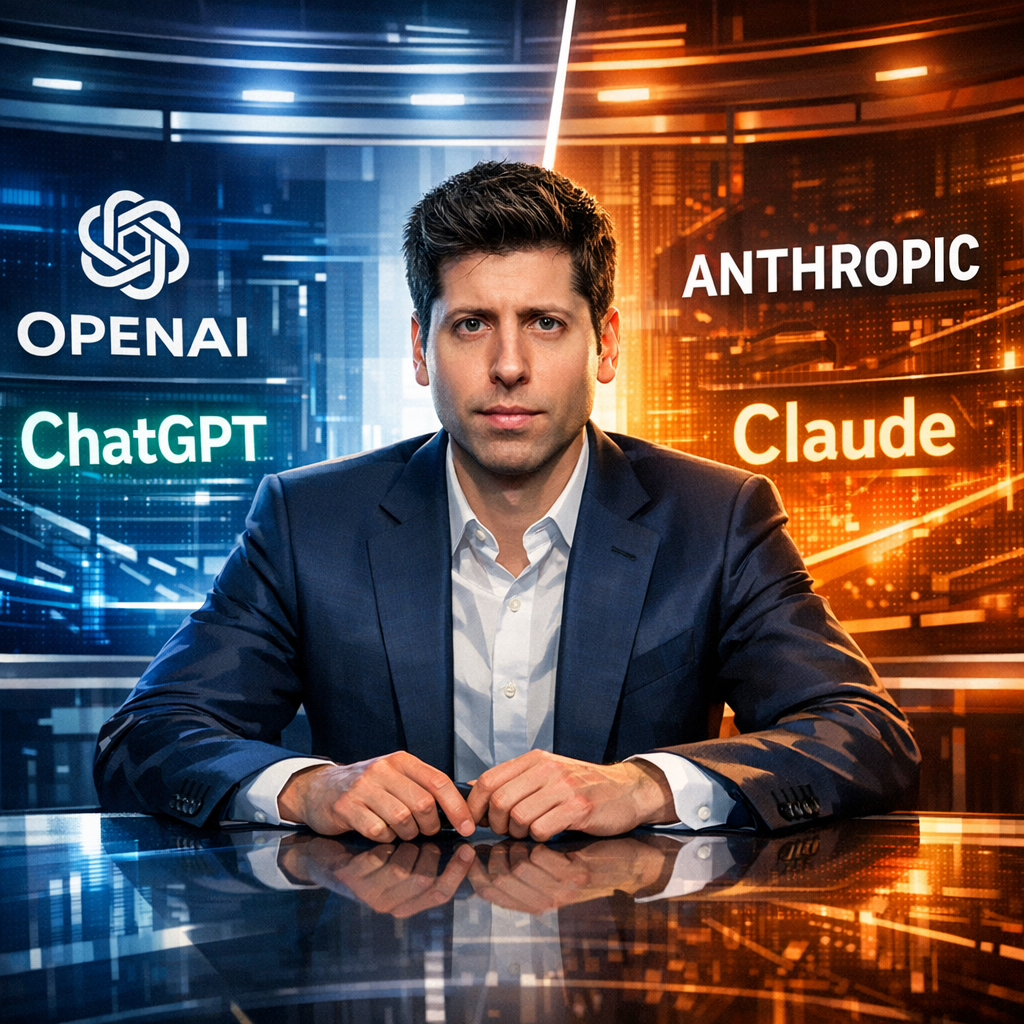
OpenAI Is Not the Same Thing as ChatGPT — and That’s the Problem
OpenAI ChatGPT rivalry 10567 is at the center of this update. Subtitle: Sam Altman has turned a product into a power center. The question is whether OpenAI can keep the mission intact while the market keeps rewarding scale.
OpenAI and ChatGPT are often spoken about as if they were interchangeable. They are not. That gap is the story.
ChatGPT is the product. OpenAI is the company. Sam Altman is the face, the amplifier, and increasingly the political object in the middle of it all.
The tension matters because it reveals what the AI race is really becoming: not just a contest over model quality, but a contest over who gets to define the category, set the narrative, and claim the moral high ground while building a very real business.
ChatGPT gives OpenAI reach; Sam Altman gives it force
Fact: ChatGPT is OpenAI’s most visible consumer product and one of the clearest symbols of the generative AI boom. OpenAI’s public materials also show a company that now sells products, services, and platform access across consumer and enterprise use cases.
Interpretation: That makes OpenAI more than a research outfit. It makes it a distribution machine. ChatGPT gives the company habit and scale. Altman gives it narrative control. Together, they make OpenAI harder to ignore than rivals that may have cleaner brands but less cultural force.
Argument: In a crowded market, force is not the same as credibility. The more ChatGPT becomes the default AI interface, the more every OpenAI decision looks like an assertion of power, not just a product update.
The OpenAI versus Anthropic split is about discipline versus dominance
Anthropic and Claude provide the clearest contrast. Anthropic has built its brand around safety, reliability, and enterprise trust. Claude is not trying to be the loudest AI assistant in the room; it is trying to look like the one companies can depend on.
Fact: Anthropic’s official materials emphasize responsible AI, safety, and enterprise use. Claude has become a serious competitor in the assistant market and a meaningful counterweight to ChatGPT in developer and business contexts.
Interpretation: This is not just a product difference. It is a strategic bet. Anthropic is telling the market that restraint can be a competitive advantage. OpenAI is answering that the market rewards reach first and philosophical purity second.
Stakes: If Anthropic proves that trust can scale, it weakens the assumption that the biggest AI company must also be the most central one. If OpenAI proves the opposite, the industry will continue to reward dominance disguised as inevitability.
The mission talk gets harder when the business keeps winning
OpenAI’s original pitch carried the language of broad benefit and long-term caution. But once a company becomes the default AI brand, that language starts colliding with commercial reality.
Fact: OpenAI has expanded well beyond its early research framing, and the company’s public posture now reflects productization, partnerships, and platform strategy.
Interpretation: That evolution is rational. It is also messy. A company cannot scale a frontier AI platform and remain emotionally outside the market it is helping create. The problem is not hypocrisy in the abstract. The problem is that the company’s growing influence makes every claim about neutrality less believable.
What changes next: Expect more pressure on OpenAI to prove that it can grow without becoming opaque, dependent on distribution partners, or overly identified with one executive’s judgment. Expect Anthropic to keep using that pressure as a strategic opening.
What users and developers will actually notice
For users, the rivalry should improve product quality in the near term. ChatGPT and Claude are both under pressure to become more useful, more reliable, and easier to integrate into daily work.
For developers, the bigger change is platform leverage. The winner is not just the model with the best benchmark story. It is the model that can become a stable layer in software workflows, with predictable pricing, strong tooling, and enough trust to keep enterprise buyers from flinching.
Fact: The AI assistant market is already crowded, and the companies that survive will be the ones that can support usage at scale without breaking their economics or their reputations.
Argument: That is why OpenAI’s identity problem is not cosmetic. It affects how developers, partners, and regulators interpret every move the company makes.
The counterpoint: ambiguity may be OpenAI’s real advantage
There is a strong case that OpenAI’s hybrid identity is not a weakness but a necessity. The AI market is still forming. A company that tries to act too pure may simply surrender the field to a faster, more commercially aggressive rival.
That is the uncomfortable truth in this race: being easy to admire is not the same as being hard to beat.
Counterpoint: Anthropic’s discipline may win trust, but OpenAI’s willingness to operate across consumer, developer, and enterprise layers may be what secures category leadership.
Sources behind the rivalry
This analysis draws on OpenAI’s official product and research pages, OpenAI blog and company announcements, Anthropic’s official product and safety materials, Claude documentation, and reputable market reporting on the AI assistant market and company strategy. Where public-company implications are relevant, the relevant lens is filings, investor materials, and competitive positioning rather than short-term market noise.
Bottom line: OpenAI’s real competition is not just Anthropic. It is the strain created when a product becomes a platform and a founder becomes the story. That is what ChatGPT, Sam Altman, and OpenAI together reveal about the AI race: power now matters as much as intelligence, and maybe more.
Related coverage: AI Chronicle analysis and updates.
Sources and further reading
- http://OpenAI%20official%20product%20and%20research%20pages
- https://openai.com/news/
- https://www.anthropic.com/news

 The Real Threat Behind AI: How Automation Is Quietly Killing Creativity and Jobs
 Sam Altman’s OpenAI: The New Power Broker in the AI Race
 How Sam Altman’s Quiet Power Shift Is Reshaping the AI Industry and Global Governance
 Why NVIDIA’s Jensen Huang Holds the Real Power in the AI Industry


