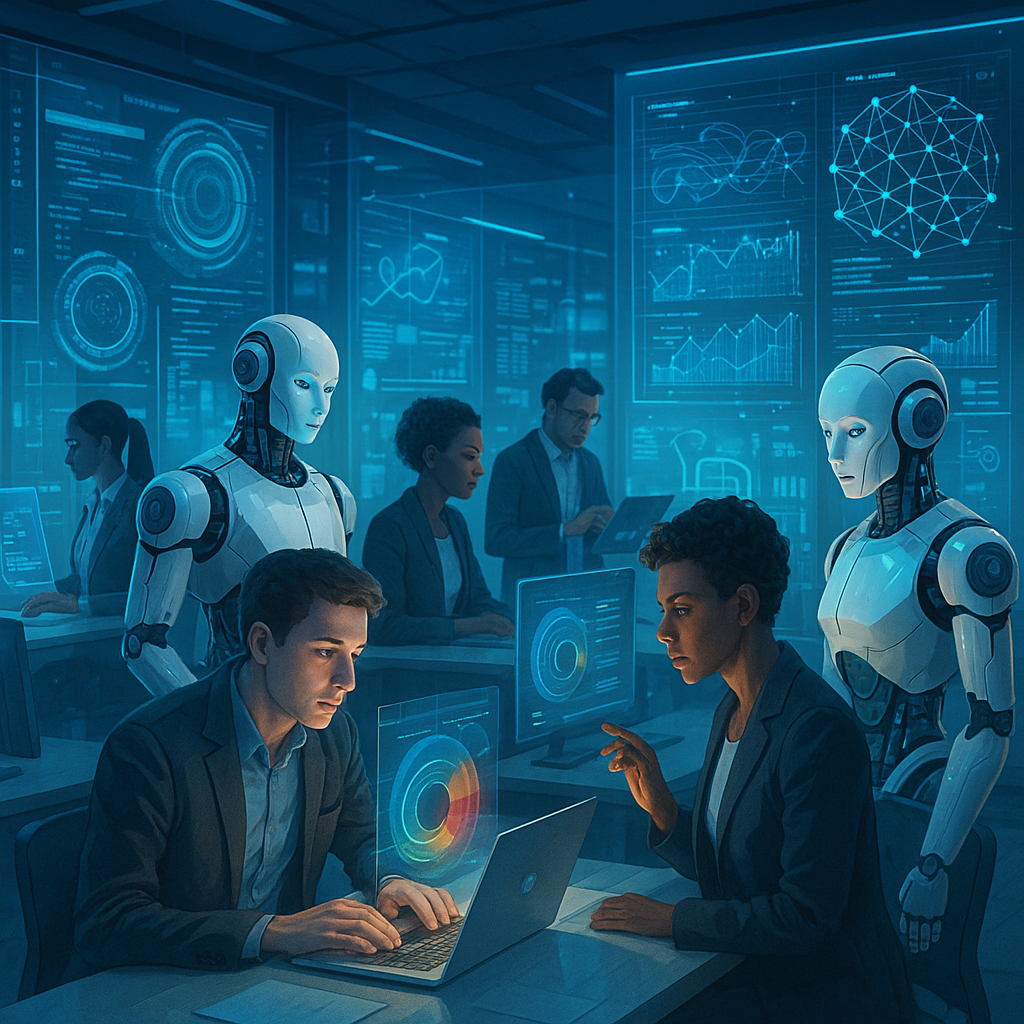
AI and the Future of Work: A Controversial Evolution
We stand at the cusp of a transformation that promises to redefine employment as we know it. Artificial intelligence, with its generative capabilities, machine learning models, and automation prowess, is no longer a tool but a force that could render many traditional roles obsolete. But should we welcome this change with open arms, or question the cost to human identity, creativity, and society?
How Automation Is Silently Redefining Jobs
Companies across industries are deploying AI-driven agents, chatbots, and autonomous systems to perform repetitive and complex tasks. From automating customer service to managing social media, AI tools can increase productivity and reduce costs. However, this efficiency comes with a trade-off: the erosion of many middle-class jobs and the marginalization of traditional skill sets.
Is the Creative Spark at Risk?
One of the biggest fears is that AI will encroach on creative professions. Tools that generate content, create images, compose music, or write code challenge the long-held belief that creativity is uniquely human. Are we facing a future where human ingenuity is drowned by algorithmic optimization and model-generated outputs? And if so, what does that mean for our culture and the value we place on original thought?
Ethical and Societal Questions AI Automation Raises
- Who controls the algorithms? Big tech firms and their CEOs often prioritize market dominance and profits over societal welfare.
- What about privacy and data security? The hunger for massive datasets to train AI risks exposing personal information and creating surveillance states.
- Is regulation just theater? Governments struggle to understand and effectively regulate fast-moving AI technologies, often lagging behind industry momentum.
- Will automation deepen inequality? Access to AI tools and education is uneven, potentially creating a new class divide between those empowered by AI and those displaced by it.
The Human Response: Adapt or Perish?
Some argue that embracing AI automation can free humans from mundane labor and unlock higher-level creative and strategic roles. Others warn that the pace of change is too fast, threatening social stability and workforce readiness. Are businesses, educators, and policymakers prepared to support this transition, or are we neglecting a looming crisis?
Conclusion: Challenging the Narrative of Inevitable AI Domination
It’s tempting to accept that AI-driven automation will simply replace human jobs and skills. But this narrative deserves scrutiny. We must ask uncomfortable questions: Who benefits? Who loses? And how can we shape a future where technology amplifies human potential rather than extinguishes it? The revolution is underway, but its ethical and societal ramifications are far from settled.

Related Articles
 Pure Storage and Microsoft Azure Drive Enterprise Readiness for AI-Enabled Data Infrastructure
 Sam Altman’s OpenAI: The Paradox of Power and Trust in AI’s Future
 ChatGPT Introduces Global Group Chat Feature to Enhance Collaborative AI Assistance
 Amazon AWS Pledges Up to $50 Billion for AI and Supercomputing Expansion in U.S. Federal Sector