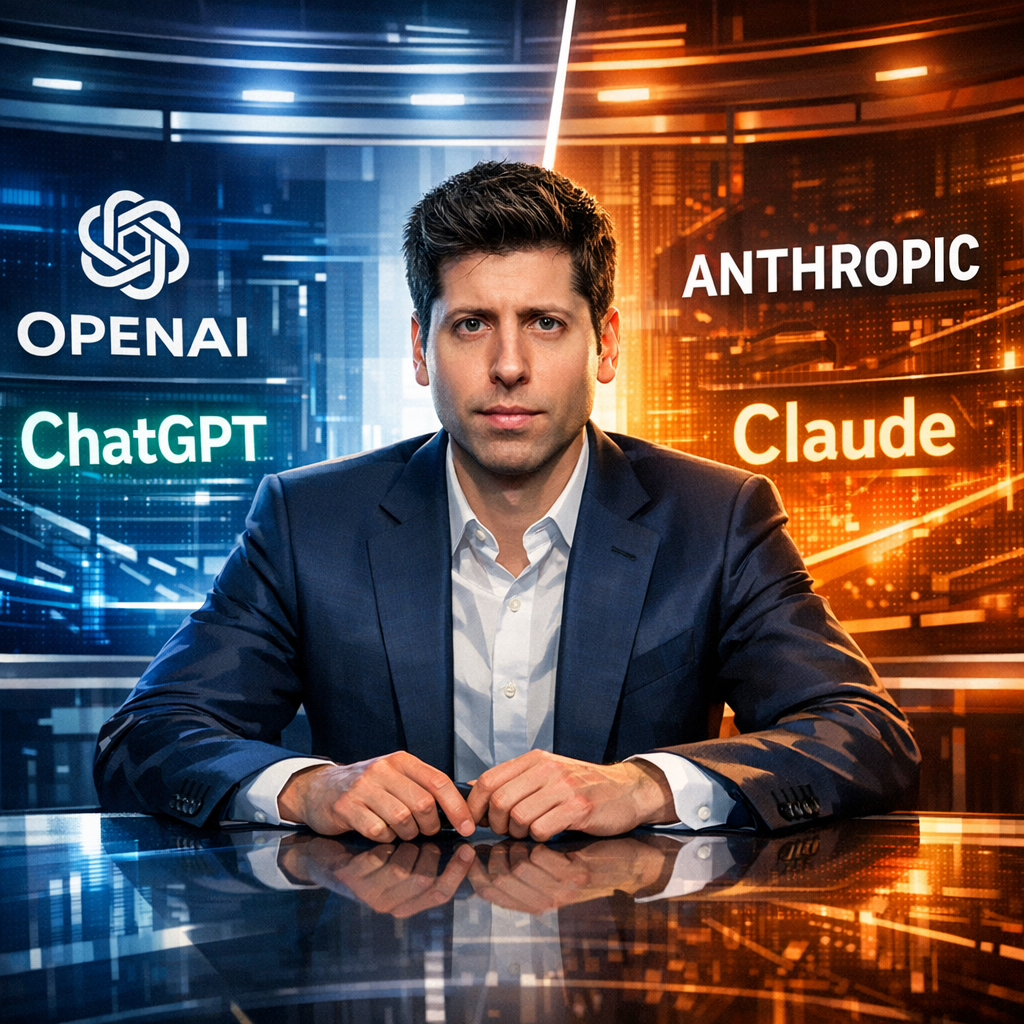
Sam Altman OpenAI power dynamics is at the center of this update. Sam Altman’s tenure at OpenAI marks a defining moment in the artificial intelligence landscape. What began as a mission-driven lab aiming to democratize AI has evolved into a commercial powerhouse that sets industry standards and shapes the competitive dynamics of AI globally. This transformation exemplifies a significant shift where leadership in AI is increasingly tied not just to innovation but to control over compute infrastructure, strategic partnerships, and governance models.
Under Altman, OpenAI’s breakthrough product, ChatGPT, rapidly gained global adoption, leveraging Microsoft’s cloud infrastructure to scale its impact. While this partnership has accelerated deployment, it has also concentrated power in the hands of a few, raising concerns about market dominance and transparency. OpenAI’s trajectory contrasts with competitors like Anthropic, which prioritize safety and cautious scaling, or Google DeepMind, which pursues patient, long-term research. Yet OpenAI’s ability to commercialize AI rapidly has set the pace for the entire industry.
However, this concentration of AI power under OpenAI’s leadership poses critical risks. The opacity of OpenAI’s governance and its evolving profit motives challenge the industry’s trustworthiness. The question becomes not only who can build the most powerful AI but who is accountable for its societal impact. The AI race is no longer simply a contest of innovations but a contest of trust, control, and strategic influence.
Nevertheless, supporters contend that OpenAI’s commercial strategy is essential to sustain the enormous investments AI development requires. Without partnerships like Microsoft’s, the deployment scale achieved by OpenAI would be unattainable. Furthermore, OpenAI continues to invest in AI safety, indicating a balance between profit and responsibility.
Looking ahead, the OpenAI-Microsoft coalition exemplifies the new paradigm where AI leadership emerges from a blend of technical innovation and infrastructure control. This concentration challenges competitors and regulators alike, shaping the AI ecosystem for years to come. Ensuring that this power is wielded transparently and responsibly is critical not just for the companies involved but for society at large.
Ultimately, Sam Altman’s OpenAI is more than a company or a product maker—it is a central player in defining the rules, risks, and rewards of the AI era. Its evolution underscores the urgent need for governance frameworks that can balance innovation with ethical accountability. The future of AI depends on more than breakthroughs; it depends on who governs the power behind them.
Related coverage: AI Chronicle analysis and updates.
Sources consulted
Why it matters
This update influences the AI race across model providers, infrastructure leaders, and enterprise adoption decisions.

 OpenAI Is No Longer Just a Model Company
 Why AI Trust Is the Real Battle Shaping the Future of Artificial Intelligence
 The AI Leadership Crisis: How Power Concentration Threatens Innovation and Ethics (2026)