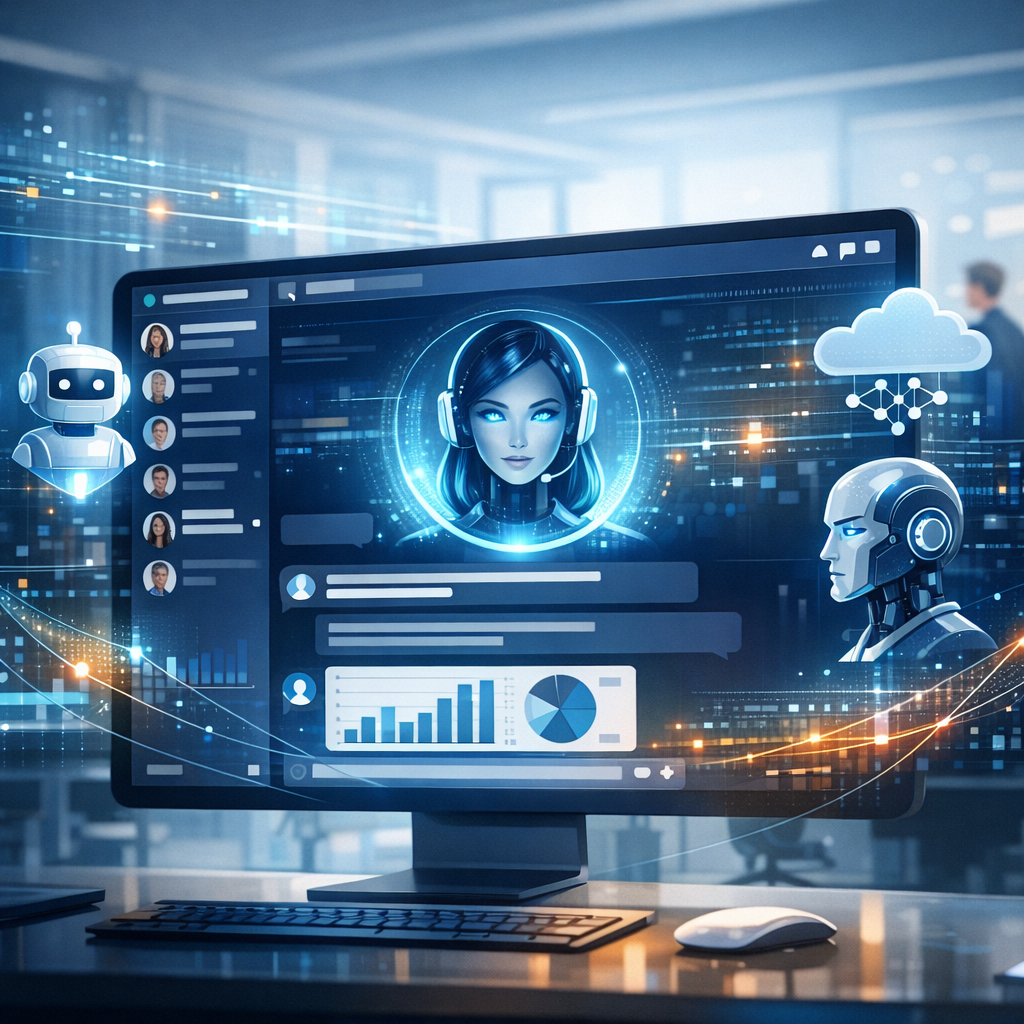
Salesforce announced on Tuesday the release of a fully revamped version of Slackbot, its workplace AI assistant. This new iteration elevates Slackbot from a simple notification tool to a comprehensive AI agent designed to search enterprise data, draft documents, and autonomously execute tasks on behalf of employees.
Now generally available to customers on Slack’s Business+ and Enterprise+ plans, this launch marks Salesforce’s most ambitious step to position Slack at the forefront of the “agentic AI” trend—software agents collaborating with humans to complete complex tasks. The move also serves to reassure investors that artificial intelligence will enhance Salesforce’s offerings rather than displace them.
Reimagining Slackbot: From Basic Tool to AI Powerhouse
Parker Harris, Salesforce co-founder and Slack’s chief technology officer, described the transformation bluntly: “The old Slackbot was, you know, a little tricycle, and the new Slackbot is like, you know, a Porsche.” The original Slackbot provided simple algorithmic functions such as reminders and notifications. In contrast, the new Slackbot is built on a sophisticated architecture leveraging a large language model (LLM) and advanced search capabilities. It can access Salesforce records, Google Drive files, calendar data, and years of Slack conversations to support user tasks.
Harris emphasized that despite the technical overhaul, the Slackbot brand was retained to maintain user familiarity. The new Slackbot’s foundation is a robust search engine integrated with third-party enterprise data sources, supporting more complex and context-aware interactions.
Powered by Anthropic’s Claude and Expanding AI Model Support
The upgraded Slackbot operates on Claude, Anthropic’s large language model, chosen in part due to compliance requirements. Slack’s commercial service maintains FedRAMP Moderate certification, enabling it to serve U.S. federal government clients, and Anthropic was reportedly the only provider meeting these compliance standards at the time of development.
Looking ahead, Salesforce plans to support additional AI models, including Google’s Gemini and potentially OpenAI’s models, reflecting the commoditization of LLMs. Harris likened LLMs to CPUs in computing, underscoring their democratization across the industry. He also stressed that Salesforce does not use customer data to train AI models, highlighting data privacy concerns.
Internal Adoption Demonstrates Strong User Engagement and Productivity Gains
Salesforce has internally tested the new Slackbot with its 80,000 employees, yielding remarkable results. Ryan Gavin, Slack’s chief marketing officer, reported it is the fastest adopted product in Salesforce’s history, with two-thirds of employees trying it and 80% continuing regular use.
User satisfaction reached an impressive 96%, the highest for any Slack AI feature to date. Employees reported saving between two and 20 hours weekly. Adoption was driven largely by organic social sharing rather than top-down mandates, fostering a collaborative environment for sharing effective Slackbot prompts.
From Disparate Data to Actionable Insights
Slackbot’s ability to synthesize data from multiple sources was demonstrated in a product presentation where it analyzed customer feedback alongside usage dashboards, correlating qualitative and quantitative data. It can also query Salesforce to identify enterprise accounts for targeted actions and generate collaborative documents within Slack’s Canvas format.
Rob Seaman, Slack’s chief product officer, highlighted that this integration points toward future expansions where Slackbot will interact with additional third-party tools, enhancing its role as a multifunctional workplace assistant.
Pilot Customers Report Significant Productivity Improvements
Among early adopters is Beast Industries, the company behind YouTube personality MrBeast. Luis Madrigal, Beast Industries’ CIO, praised the straightforward deployment and robust security model, which limits Slackbot’s access to only data each user is authorized to view.
Employees at Beast Industries reported saving at least 90 minutes daily using Slackbot, while other pilot customers such as Slalom, reMarkable, and Engine noted meaningful time savings and reduced context switching.
Competitive Landscape: Slackbot vs. Microsoft Copilot and Google Gemini
Salesforce’s new Slackbot directly challenges Microsoft Copilot, integrated within Teams and Microsoft 365, and Google’s Gemini-powered Workspace tools. Slack executives emphasize Slackbot’s advantage in offering contextual, seamless AI assistance embedded directly within Slack, eliminating the need for extra setup or switching between apps.
Harris described Slackbot as an “employee super agent” designed to provide personalized, context-rich support, akin to the consumer AI experience popularized by ChatGPT but tailored for enterprise use.
Vision for Slackbot as the Central AI Hub
Salesforce envisions Slackbot evolving into a “super agent” capable of coordinating with other AI agents across organizations. The platform already hosts third-party agents, including coding assistants from Anthropic and others from OpenAI and Google.
Harris anticipates that Slackbot will become an MCP (Model Context Protocol) client, integrating diverse AI tools into a unified interface. However, he cautioned that widespread multi-agent coordination is still emerging, expecting more progress by fiscal year 2026.
Pricing and Potential Cost Implications for Customers
Slackbot is included at no extra cost for Business+ and Enterprise+ Slack customers. However, some enterprises might face higher expenses due to Salesforce’s updated pricing policies on API access, which could impact third-party integrations and data strategies.
Current Features and Roadmap
The rollout of the new Slackbot began immediately and will cover all eligible customers by the end of February, with mobile support expected by early March. While calendar reading and availability checking are available at launch, meeting booking and image generation features are planned for future releases.
Salesforce has not disclosed specific plans regarding integration with competing CRM systems, leaving that as a competitive differentiator in the market.
The Future of Work and Conversational AI
Salesforce’s launch underscores its belief that conversational AI, accessed through chat interfaces like Slack, will define the future of enterprise work. Harris outlined the company’s goal for Slackbot to proactively surface relevant information, reducing the need for manual searches.
He acknowledged the significant value LLMs bring to unstructured data within Slack, streamlining knowledge sharing and decision-making. Harris also predicted that AI interfaces will evolve beyond pure conversation to more adaptive formats tailored to user intent.
With Microsoft, Google, and numerous startups investing heavily in embedded AI, the competition to become the invisible layer of workplace intelligence is intensifying. For Salesforce, Slackbot represents a strategic bet to turn the millions of daily Slack conversations into a competitive advantage rather than a vulnerability.
As Salesforce account executive Haley Gault put it, “I honestly can’t imagine working for another company not having access to these types of tools. This is just how I work now.” This sentiment encapsulates Salesforce’s vision for Slackbot’s role in the modern workplace.
Fonte: ver artigo original

 Tokenize: LDN 2025 to Showcase Pioneering Web3 and Tokenization Innovations at Excel London
 Jury Finds Elon Musk Misled Twitter Investors Over Bot Claims During Acquisition Dispute
 Bending Spoons Acquires Eventbrite for $500M to Revitalize the Struggling Brand