What happened
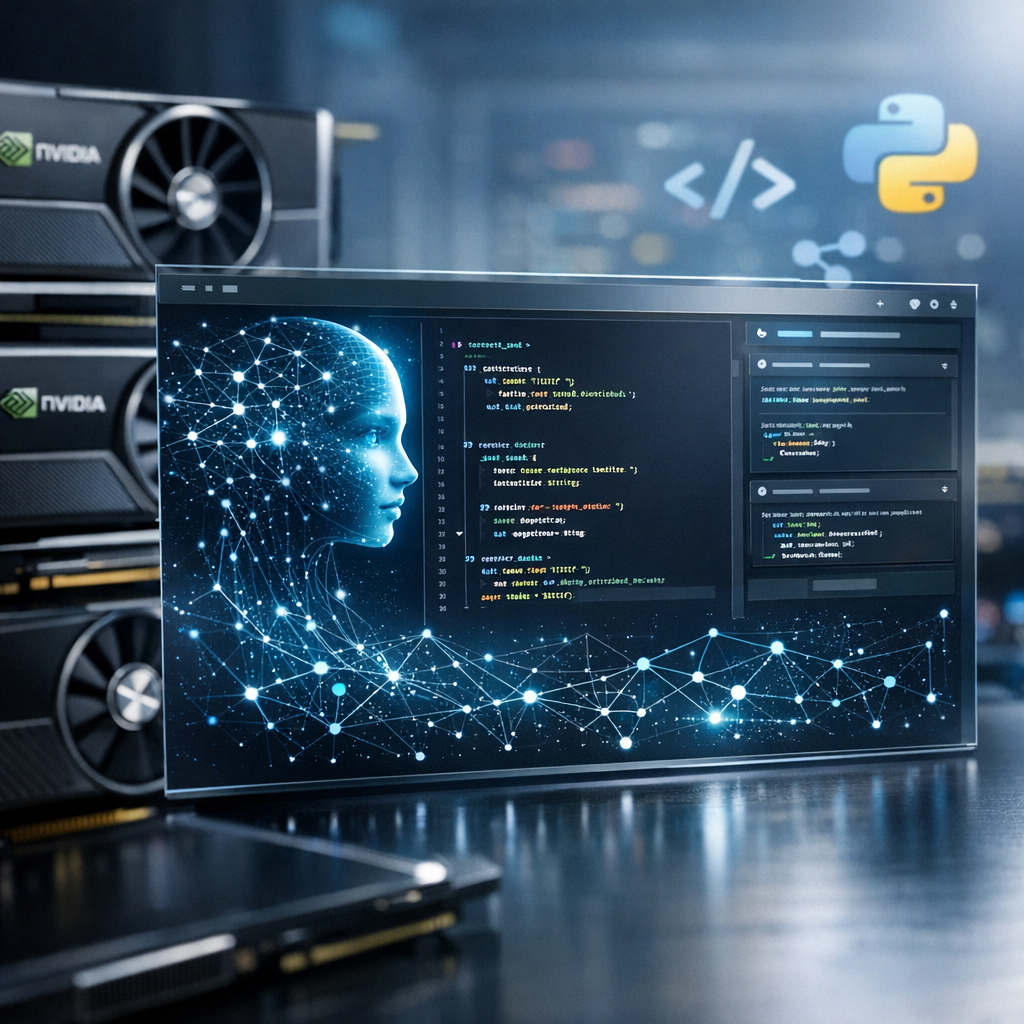
NousCoder 14B Open Source Coding is at the center of this update. Nous Research introduces NousCoder-14B, an open-source AI model designed for competitive programming that rivals proprietary systems like Anthropic's Claude Code. Trained in just four days on Nvidia B200 GPUs, the model achieves notable accuracy and transparency, signaling a shift in AI-assisted software development.
Nous Research, an open-source AI startup supported by crypto venture firm Paradigm, has unveiled NousCoder-14B, a new AI model targeting competitive programming tasks. Released at a time when Anthropic’s agentic programming tool Claude Code is gaining widespread attention, NousCoder-14B claims to match or surpass several larger proprietary models. Remarkably, it was trained in just four days using 48 of Nvidia’s latest B200 graphics processors.
NousCoder-14B achieved a 67.87% accuracy rate on LiveCodeBench v6, a standardized benchmark evaluating competitive programming challenges published between August 2024 and May 2025. This performance marks a 7.08 percentage point improvement over its base model, Alibaba’s Qwen3-14B, underscoring notable progress in open-source AI coding capabilities.
Open-Source Transparency and Replicability
Distinct from many AI model releases, Nous Research has openly published not only the model weights but also the entire reinforcement learning environment, benchmark suite, and training harness through its Atropos framework. This radical transparency enables researchers with sufficient computational resources to reproduce or extend the work, fostering an open research ecosystem.
Joe Li, a Nous Research resident researcher and former competitive programmer, led the training process. He drew parallels between the model’s improvement trajectory and his own rise on Codeforces, a competitive programming platform. While Li’s personal journey from a 1600-1750 rating to 2100-2200 took nearly two years and about 1,000 solved problems, NousCoder-14B achieved a comparable leap within four days but required 24,000 problems, highlighting current disparities in learning efficiency between humans and AI.
Advanced Reinforcement Learning Techniques
NousCoder-14B’s training leveraged verifiable rewards, where generated code is tested against numerous test cases and receives binary feedback—correct or incorrect. The model was trained using Modal’s cloud platform to run sandboxed code execution in parallel, handling extensive test suites with strict time and memory constraints.
The team employed Dynamic Sampling Policy Optimization (DAPO), an approach that improves learning by selectively focusing on training examples offering meaningful feedback. Additionally, iterative context extension expanded the model’s token processing window from 32,000 to 40,000 tokens during training, with evaluation reaching up to 80,000 tokens for optimal results. Parallel inference and verification pipelines maximized GPU cluster efficiency.
Addressing Data Scarcity in AI Coding
A critical insight from the technical report is that NousCoder-14B’s training dataset encompasses most publicly available, verifiable competitive programming problems in a standardized format. This suggests the domain is nearing its limits for high-quality training data, posing challenges for further improvements.
Unlike natural language tasks, coding requires exact correctness, complicating synthetic data generation. To overcome this, researchers are exploring models that can generate solvable problems themselves, enabling a form of self-play to create new training data and extend learning capabilities.
Competing with Big Tech through Open-Source Innovation
Nous Research has positioned itself as a significant player in the AI landscape by committing to open-source AI development that competes with proprietary models. After raising $50 million in funding led by Paradigm in April 2025, the startup has released models like Hermes 4, which reportedly outperform ChatGPT without content restrictions, and DeepHermes-3, a toggle-on reasoning model enhancing user control over AI thinking processes.
While some critics question the company’s anime-inspired branding and benchmark claims, the technical community acknowledges the value of open-source transparency amid intense competition from industry giants like OpenAI, Anthropic, and Nvidia.
The Future of AI Coding Tools
Looking ahead, Nous Research highlights the need for multi-turn reinforcement learning where intermediate feedback from test cases informs iterative solution refinement, improving accuracy beyond one-shot attempts. Managing response length remains another challenge, as longer incorrect solutions tend to saturate model context windows.
The most ambitious future direction involves integrating problem generation with self-play training, enabling AI models to autonomously create and solve programming problems. This could alleviate data scarcity and push AI coding tools beyond current human benchmarks.
NousCoder-14B is available under an Apache 2.0 license on Hugging Face, along with the complete Atropos training stack for researchers and developers seeking to build upon this work.
The rapid progress in AI coding models raises a pivotal question: it is no longer whether AI can learn to code, but whether these systems will soon become better educators and innovators in software development than humans have ever been.
Fonte: ver artigo original
Related coverage: AI Chronicle analysis and updates.
Why it matters
This update influences the AI race across model providers, infrastructure leaders, and enterprise adoption decisions.

Related Articles
 Apple Launches MacBook Neo: A Vibrant, AI-Powered Alternative to Chromebooks Starting at $599
 Claude Code Creator Unveils Revolutionary AI-Powered Coding Workflow, Sparking Developer Enthusiasm
 OpenAI Reports Shift from AI Pilots to Deep Workflow Integrations in Enterprises
 Grok AI Evolution: Key Improvements and Remaining Challenges from Version 1.0 to 4.1