When the creator behind Claude Code, one of the most advanced AI coding agents, revealed his personal workflow, the developer community responded with intense interest and optimism about the future of software engineering.
Boris Cherny, who leads Claude Code development at Anthropic, shared a detailed thread on X (formerly Twitter) explaining how he manages multiple AI agents in parallel to accomplish coding tasks more efficiently than traditional methods. Industry experts have hailed this revelation as a pivotal moment, potentially marking a new era for AI-assisted programming.
Orchestrating Multiple AI Agents for Enhanced Productivity
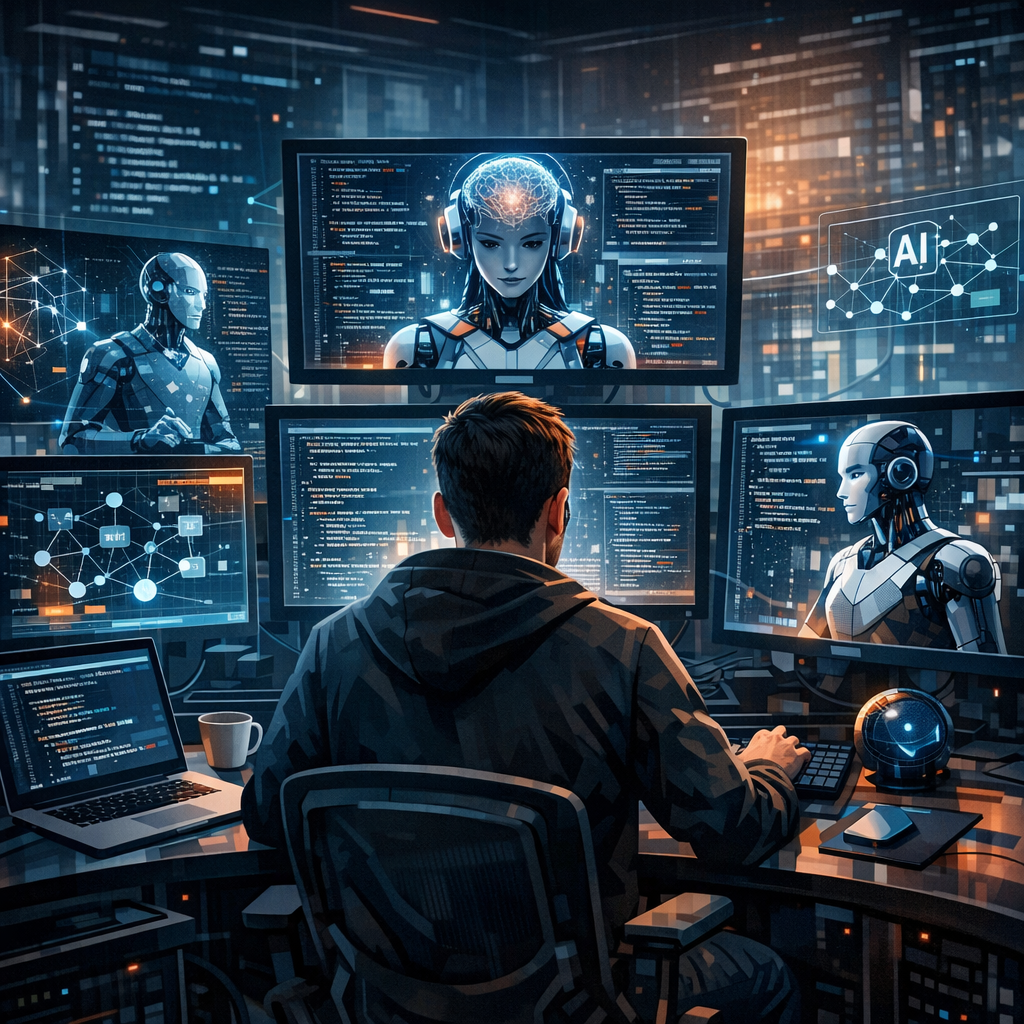
Unlike conventional software development, which often follows a linear “inner loop” process of coding and testing sequentially, Cherny’s approach treats AI agents as an autonomous workforce managed simultaneously. He runs five instances of Claude in parallel using his terminal, each handling distinct tasks such as testing, refactoring, and documentation.
By leveraging system notifications through iTerm2, Cherny efficiently coordinates these concurrent workflows. Additionally, he operates several browser-based Claude sessions, seamlessly transferring work between his local environment and the web via custom “teleport” commands.
This method exemplifies Anthropic’s “do more with less” philosophy, emphasizing intelligent orchestration over massive infrastructure investment, contrasting with competitors focusing on extensive hardware scaling.
Choosing the Smartest, Though Slower, AI Model for Superior Results
Contrary to the industry’s focus on speed, Cherny exclusively uses Anthropic’s largest and slowest AI model, Opus 4.5. He explains that despite its latency, this model requires less human intervention due to its advanced reasoning and tool usage capabilities, ultimately accelerating development by reducing correction time.
This insight challenges the prevailing assumption that faster output models are more efficient, highlighting that human time spent fixing AI errors is the real bottleneck in AI-assisted coding.
Transforming AI Mistakes Into Lasting Knowledge
To overcome AI’s lack of persistent memory across sessions, Cherny’s team maintains a centralized file called CLAUDE.md within their git repository. Whenever Claude makes an error, it is documented there, allowing the AI to learn and avoid repeating the same mistakes in future interactions.
This creates a dynamic, self-improving codebase where human reviewers not only fix bugs but also update the AI’s behavioral guidelines. As Aakash Gupta, a product leader analyzing the workflow, noted, “Every mistake becomes a rule,” enabling Claude to become smarter over time.
Automating Routine Tasks Through Slash Commands and Specialized Subagents
Cherny incorporates automation by using slash commands—custom shortcuts embedded in the project—to streamline complex workflows. One frequently used command, /commit-push-pr, automates the entire process of committing code, pushing changes, and opening pull requests, saving considerable time.
Furthermore, subagents specialize in particular phases of development, such as simplifying code architecture post-development and conducting comprehensive app verification through end-to-end testing before deployment.
Verification Loops: The Key to Reliable AI-Generated Code
A crucial factor behind Claude Code’s rapid growth to over $1 billion in annual recurring revenue is its built-in verification mechanism. Claude not only writes code but also tests it autonomously using browser automation and test suites. This iterative testing ensures the user interface functions correctly and the user experience meets quality standards.
Cherny highlights that enabling AI to verify its output improves final code quality by two to three times, a significant leap beyond simple text generation.
Implications for the Future of Software Engineering
The strong community response to Cherny’s workflow underlines a fundamental shift in software development paradigms. AI is no longer a mere autocomplete aid but an integral operating system for engineering work, effectively amplifying human productivity by a factor of five.
As Jeff Tang, a prominent developer, summarized, embracing AI as a labor force rather than just an assistant will distinguish the most productive programmers, who will operate at a different level from those relying solely on traditional coding methods.
These advancements indicate that the integration of AI into everyday programming tasks is set to redefine software engineering, promoting efficiency, automation, and continuous learning within development teams.
Fonte: ver artigo original

Related Articles
 Meta Boosts Solar Energy Capacity by 100MW to Power New AI Data Center in South Carolina
 CIOs Shift to Strategic AI Leadership in 2026 After Rapid Adoption in 2025
 AMI Labs: A Billion-Dollar Startup Pursuing a New Path in AI Development
 Toyota Reinforces Commitment to Hybrid Vehicles with $10 Billion US Investment