Nous Research, an open-source AI startup supported by crypto venture firm Paradigm, has introduced NousCoder-14B, a new competitive programming AI model designed to match or surpass several larger proprietary systems. Remarkably, the model was trained in just four days utilizing 48 Nvidia B200 graphics processors, underscoring rapid progress in AI coding capabilities.
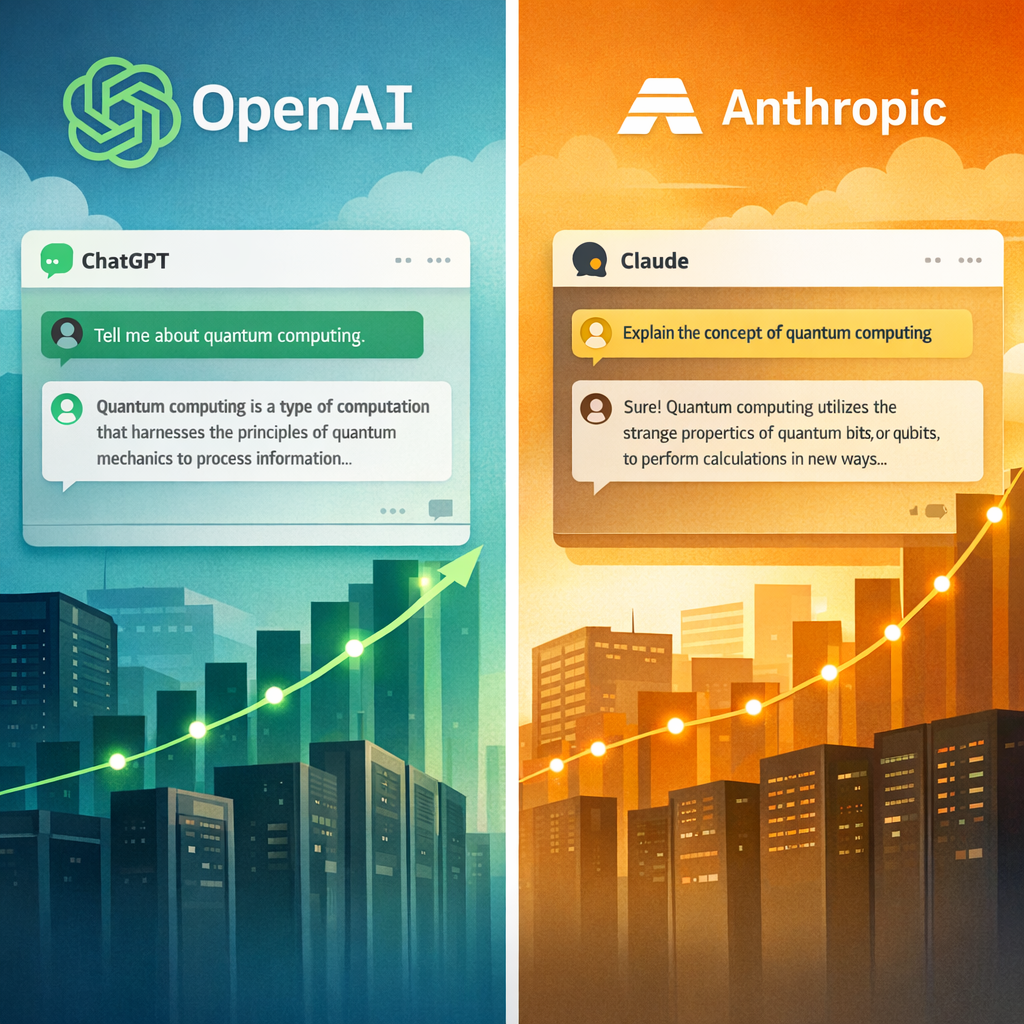
Arriving amid the surge of interest in AI coding assistants, NousCoder-14B enters a competitive landscape currently energized by Anthropic’s Claude Code, which has garnered significant attention on social media for its agentic programming abilities. This convergence of innovations highlights both the speed of development in AI-assisted software creation and the intense competition among companies aiming to establish foundational technologies for future software development.
Performance and Technical Achievements
NousCoder-14B achieves a 67.87% accuracy rate on LiveCodeBench v6, a benchmark testing AI models against competitive programming challenges published between August 2024 and May 2025. This represents a 7.08 percentage point improvement over its base model, Alibaba’s Qwen3-14B, according to a detailed technical report released by Nous Research.
Google principal engineer Jaana Dogan shared a viral account of Claude Code generating in an hour what her team had developed over a year, illustrating the transformative potential of AI coding tools. In contrast, Nous Research emphasizes the importance of open-source transparency and verifiable problem-based training as key differentiators, aiming to close the gap with proprietary solutions.
Open-Source Commitment and Reproducibility
What sets NousCoder-14B apart is its commitment to openness. Nous Research has published not only the model weights but also the complete reinforcement learning environment, benchmark suite, and training tools via its Atropos framework. This enables researchers with adequate computing resources to reproduce or extend the model’s capabilities.
The model was trained by Joe Li, a former competitive programmer and Nous Research researcher, who compared the model’s rapid improvement to his personal advancement on Codeforces, a competitive programming platform. While Li achieved a significant performance leap over two years solving about 1,000 problems, the AI reached a similar level within four days using 24,000 training problems, illustrating AI’s greater scale but lower sample efficiency compared to humans.
Innovative Training Techniques
NousCoder-14B’s training leverages reinforcement learning with verifiable rewards, where generated code is tested against problem-specific test cases to provide binary feedback — correct or incorrect. This requires substantial infrastructure, including Modal’s cloud platform to execute sandboxed code in parallel under strict time and memory limits.
The team employed Dynamic Sampling Policy Optimization (DAPO), which refines training by excluding problems that the model either solves perfectly or fails entirely, focusing learning on more informative examples. They also used iterative context extension, progressively increasing the model’s context window size up to 80,000 tokens during evaluation to boost accuracy.
Moreover, the training pipeline overlaps solution generation and verification, with asynchronous parallel model instances maximizing hardware utilization on costly GPU clusters.
Challenges and Future Directions
A significant concern highlighted in the technical report is the scarcity of high-quality, verifiable competitive programming problems, with the training dataset representing a substantial portion of all available problems. This data limitation poses a bottleneck for further advances, as rigorous automatic verification is essential in programming tasks.
To address this, researchers are exploring synthetic data generation and data-efficient algorithms. Joe Li suggests that enabling AI models to generate solvable problems themselves — a form of self-play — could be a promising path forward, similar to strategies used in game-playing artificial intelligence.
Funding and Industry Context
Nous Research has secured $65 million in funding, including a $50 million round led by Paradigm, reflecting strong investor confidence in decentralized and open-source AI development approaches. The startup has previously released models such as Hermes 4 and DeepHermes-3, which reportedly outperform ChatGPT without content restrictions and offer toggle-on reasoning features.
The company’s distinct anime-themed branding and community engagement have drawn mixed reactions, with some skepticism about prioritizing style over substance, while others debate technical aspects of model performance and practical application.
Looking Ahead: Enhancing AI Coding Capabilities
Future research directions include multi-turn reinforcement learning, where models receive intermediate feedback on compilation errors and partial failures rather than a single pass/fail signal, potentially improving iterative problem-solving skills. Controlling response length remains a challenge, as incorrect solutions tend to be longer and saturate context windows.
Ultimately, the ambition is for AI to autonomously generate and solve programming problems, effectively creating self-guided curricula that could accelerate learning and innovation beyond current human benchmarks.
NousCoder-14B is available under an Apache 2.0 license on Hugging Face, along with the complete Atropos training stack for the research community. This release marks a significant milestone, demonstrating that open-source AI can compete with proprietary giants and pushing the boundaries of how AI will shape the future of coding and software development.
Fonte: ver artigo original

Related Articles
 Asian AI Startups Challenge U.S. Dominance Amid Anthropic’s Export Ban
 Nvidia Unveils Advanced AI Models for Autonomous Driving and Speech Processing at NeurIPS
 ATN Leads Thermal Binocular Market in 2026 with Advanced Long-Range Detection Technology
 Terence Tao Highlights GPT-5.2 Pro’s Erdős Problem Breakthrough but Urges Caution on Its Significance