ChatGPT’s growth story now has a cost story attached
OpenAI ChatGPT rivalry 10346 is at the center of this update. AI’s latest market problem is not a lack of demand. It is the price of serving that demand. The Verge’s framing points to a shift Wall Street has been waiting for: the AI boom is getting expensive enough that investors are starting to ask who can keep scaling without breaking the economics.
That question lands directly on OpenAI and ChatGPT. Sam Altman’s company has built its market power around reach, frequency, and product momentum. But the more ChatGPT becomes a default interface, the more every response has to clear a cost hurdle in chips, cloud, and inference.
OpenAI’s scale-first model versus Anthropic’s discipline pitch
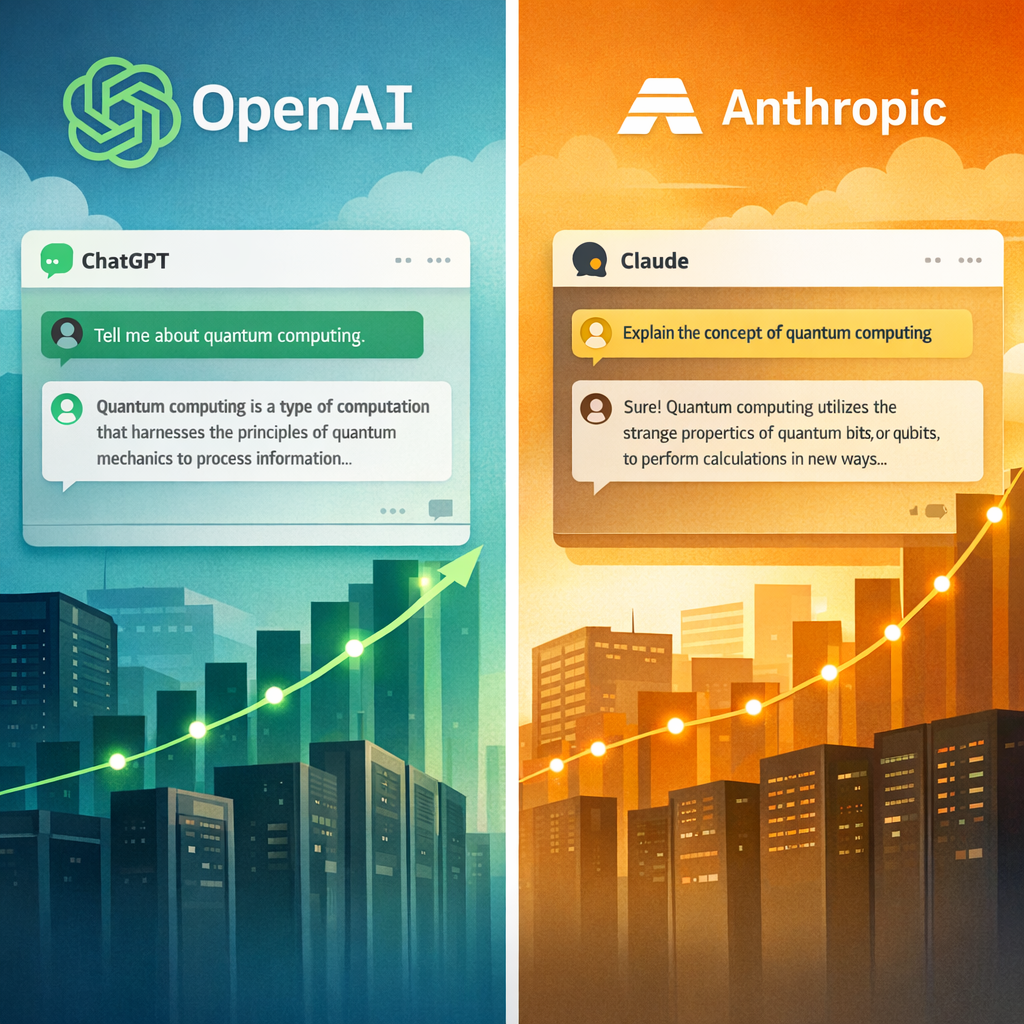
The rivalry with Anthropic and Claude is not only about model quality. It is about strategic posture. OpenAI has long been associated with aggressive expansion, broad consumer adoption, and a platform ambition that stretches far beyond one chatbot. Anthropic has often been read as the more measured rival, with Claude positioned as a serious assistant for enterprise and professional use.
If AI spending is what is making Wall Street nervous, then the market is starting to reward a different kind of argument: not just who has the best model, but who can deliver that model at a sustainable cost structure. That does not automatically favor Anthropic, but it does make the comparison sharper.
What the AI race changes for users and developers
For users, the practical consequence could be tighter product limits, more tiered pricing, or a stronger push toward enterprise plans. For developers, it could mean that model access becomes more sensitive to usage intensity, latency, and pricing predictability.
That is where the OpenAI-versus-Anthropic rivalry becomes more than branding. If ChatGPT remains the most familiar consumer product but gets more expensive to operate, and Claude continues to sell itself as a serious work tool, then the market may split by use case instead of winner-take-all dominance.
Sam Altman’s challenge is not just growth, but justification
Altman’s bigger problem is not whether demand exists. It clearly does. The problem is whether the economics of serving that demand can keep up with the ambition of the story. The AI race has moved from “who can build the best model” to “who can afford to keep improving it.”
That is why this moment matters. Once investors begin to focus on costs, the conversation changes from product hype to infrastructure leverage, cloud dependence, and monetization discipline. In that environment, OpenAI’s advantage is no longer just ChatGPT’s reach. It is whether the company can turn that reach into durable economics.
Note
This article is editorial analysis, not investment advice.
What to watch in the next phase of the ChatGPT-Claude rivalry
The key signals are straightforward: pricing changes, enterprise adoption patterns, product limits, and any public evidence that AI leaders are trying to slow the burn rate of model serving. If those pressures intensify, the rivalry between OpenAI and Anthropic will increasingly be decided by efficiency as much as capability.
The source material is thin, so the safest conclusion is also the most important one: the AI boom is still alive, but the market is becoming less willing to fund unlimited scale without a clearer path to returns.
Related coverage: AI Chronicle analysis and updates.
Sources and further reading
- http://The%20Verge,%20AI’s%20finally%20expensive%20enough%20to%20make%20Wall%20Street%20nervous
- https://openai.com/news/
- https://www.anthropic.com/news

Related Articles
 Nvidia Unveils Rubin: A Cutting-Edge AI Chip Architecture Revolutionizing Computing
 Indian IT Giants Deploy Over 200,000 Microsoft Copilot Licenses to Boost Enterprise AI Adoption
 Google’s AI Edge: Leveraging User Data to Enhance Personalized Assistance
 Nous Research Launches Open-Source AI Coding Model NousCoder-14B Amid Rising AI Programming Tools Competition