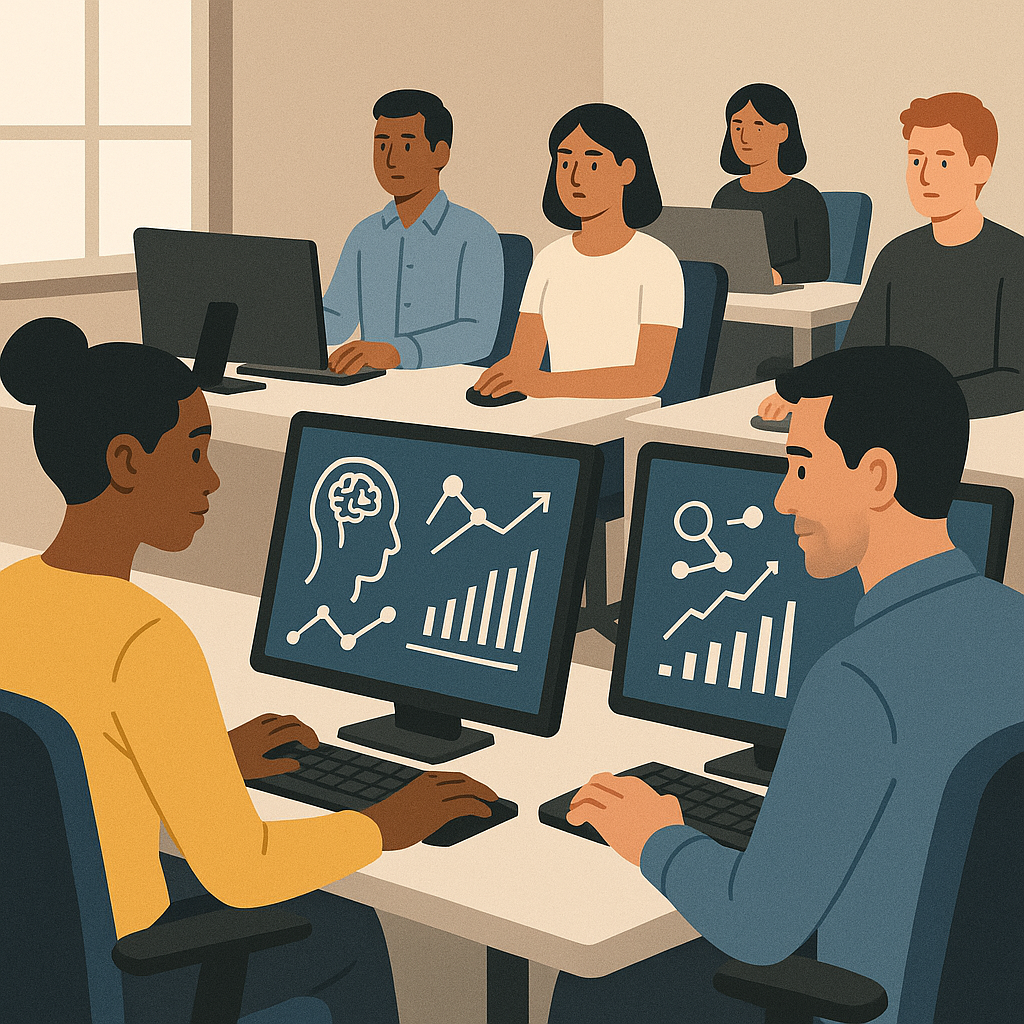
Despite widespread access to AI tools like ChatGPT Enterprise across millions of employees worldwide, a pronounced divide is emerging between those who integrate artificial intelligence deeply into their daily tasks and those who engage with it minimally. This gap is reshaping workplace dynamics and redefining what it means to be skilled in the AI era.
Uniform Access, Uneven Usage
OpenAI’s latest report, analyzing data from over one million business users, shows that employees in the top 5% of AI adoption send six times more messages to ChatGPT than the average employee within the same companies. The disparity is even more dramatic in specific areas: power users send 17 times more coding-related queries and data analysts in this group use AI tools 16 times more than their median counterparts.
The tools and capabilities are uniformly available to all employees, yet a significant portion of users remain light or infrequent AI users. Approximately 19% of monthly active users have never tried AI-powered data analysis, 14% have not used reasoning features, and 12% have abstained from using search functionalities. Conversely, among daily AI users, nearly all have engaged with these core features, highlighting a gap rooted in habitual use rather than access.
Impact of Diverse AI Usage on Productivity
The report highlights that employees experimenting across multiple AI applications—such as coding, data analysis, image generation, and writing—achieve notably higher time savings, claiming up to five times more saved hours than those using fewer AI functions. Those who save more than 10 hours weekly consume eight times more AI resources, suggesting a reinforcing cycle where broader AI engagement leads to greater productivity and career advancement opportunities.
Seventy-five percent of surveyed workers report accomplishing tasks previously out of reach, including programming support and technical troubleshooting, effectively expanding their job roles. Those not adopting AI tools risk falling behind as their job scope potentially narrows.
The Corporate AI Paradox: Large Investments, Limited Returns
Despite significant investments estimated between $30 billion and $40 billion in generative AI projects, a separate MIT study reveals that only 5% of organizations witness transformative outcomes. This phenomenon, termed the “GenAI Divide,” delineates a split between a few successful enterprises and many stuck in pilot phases. Notably, only the technology and media sectors show meaningful AI-driven business transformation.
Shadow AI Economy Fuels Adoption
MIT’s research exposes a “shadow AI” economy where over 90% of employees use personal AI tools at work despite only 40% of companies purchasing official licenses. This grassroots adoption often outperforms formal corporate initiatives in terms of return on investment and speed of integration. Employees proactively experimenting with AI on their own time are advancing faster than those awaiting formal corporate programs.
Technical Work Reflects the Largest Usage Gaps
The biggest divides between frontier and median users appear in specialized technical tasks such as coding, writing, and data analysis—areas where AI has made rapid strides. For example, coding-related AI interactions among ChatGPT Enterprise users outside traditional tech departments increased 36% over six months, enabling employees in marketing or HR to automate workflows and transform their job roles.
Academic studies suggest AI can equalize performance within users, helping lower-performing employees catch up. However, since a substantial share of workers remain light or non-users, this equalizing effect is limited to those who actively engage with AI.
Organizational Divide Mirrors Individual Usage Gap
Not only individuals but entire companies exhibit varying AI adoption levels. Top-performing firms generate twice as many AI interactions per employee as median companies, with a sevenfold increase when using custom AI tools tailored to specific workflows. This indicates fundamentally different operational models: median firms treat AI as an optional productivity tool, while frontier firms embed AI deeply into core processes and infrastructure.
Yet, about 25% of enterprises have not enabled AI connectors to access company data—a fundamental step for maximizing AI effectiveness. MIT’s study also shows that organizations purchasing AI from specialized vendors are twice as likely to succeed compared to those developing AI internally.
Challenges Lie in Organizational Adaptation, Not Technology
With OpenAI releasing new AI features every three days, the pace of technological advancement outstrips many companies’ ability to adapt. The main bottleneck is organizational structure, culture, and change management rather than AI capabilities or regulations. Leading companies invest in executive support, data readiness, workflow standardization, and continuous evaluation to foster AI adoption as a strategic priority.
Many organizations, however, rely on hope that employees will independently discover and propagate AI best practices, a strategy that the reported sixfold productivity gap suggests is ineffective.
The Narrow Window to Bridge the AI Divide
Enterprise AI contracts set for the next 18 months create a shrinking opportunity to close the adoption gap. Organizations that bridge the “GenAI Divide” earliest will likely shape the future of business operations.
While these insights stem from self-reported data and may carry inherent biases, the core conclusion is clear: mere access to AI tools does not ensure adoption. The divide reflects behavioral differences in usage intensity and integration into workflows, echoing historical patterns seen with technologies like spreadsheets and email.
Currently, 90% of users prefer humans for complex, mission-critical tasks, whereas AI has taken precedence for simpler work. The workforce segment pulling ahead does so by consistently leveraging AI capabilities already available to all, underscoring that the productivity gap is driven by user behavior rather than technology access.
The sixfold productivity gap reveals a new dimension of workplace stratification in the AI age, emphasizing the critical role of organizational culture and employee initiative in harnessing AI’s full potential.
Fonte: ver artigo original

Related Articles
 Microsoft Research’s Mirage Advances Video Generation with Latent Space Spatial Memory
 OpenAI Launches Frontier Platform to Help Enterprises Deploy AI Agents for Real-World Tasks
 Former OpenAI Policy Chief Launches Institute for Independent AI Safety Audits
 Microsoft Denies Report of Lowering AI Sales Targets Amid Fiscal Challenges