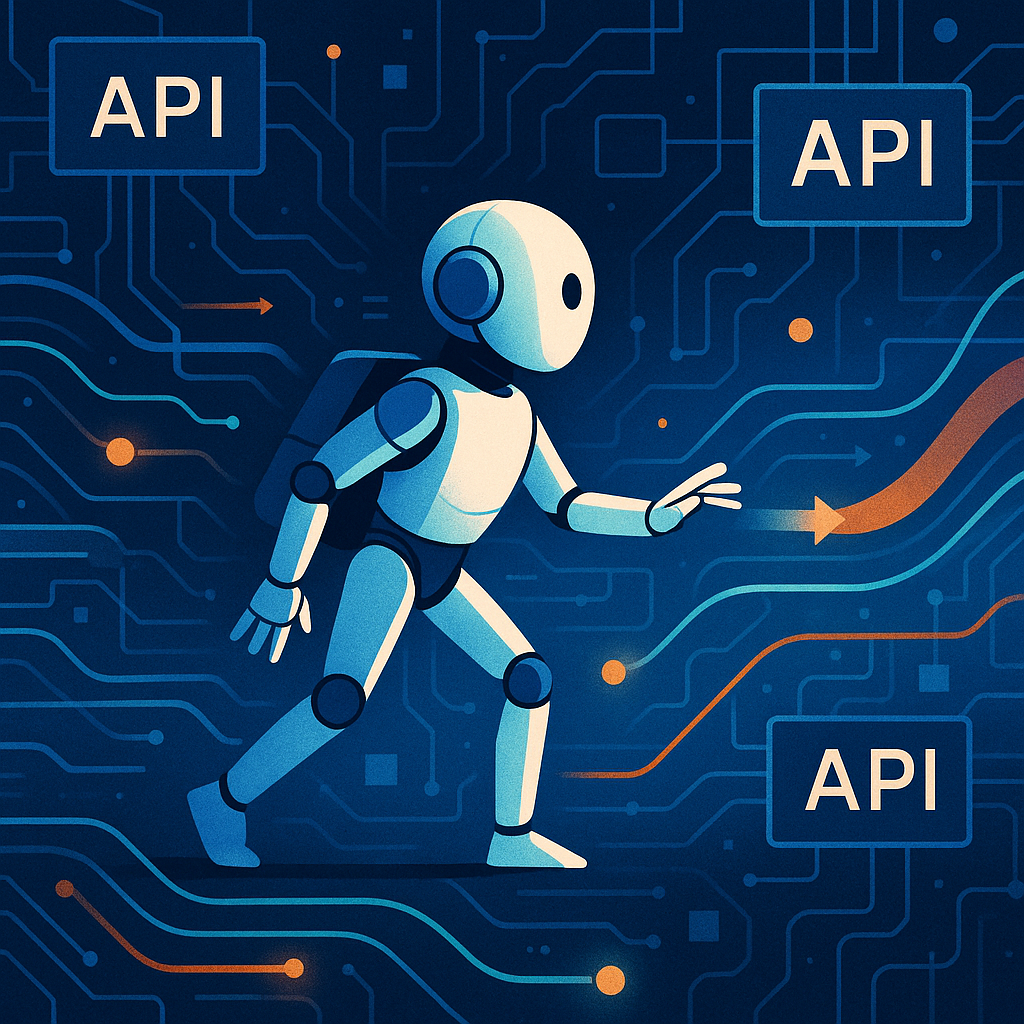
Researchers at Alibaba’s Tongyi Lab have introduced AgentEvolver, an innovative framework designed to enable AI agents to autonomously generate their own training data by exploring their operational environments. This approach leverages the reasoning capabilities of large language models (LLMs) to reduce the traditionally high costs and labor-intensive efforts associated with creating task-specific datasets.
In comparative experiments, AgentEvolver demonstrated superior efficiency in environment exploration and data utilization compared to conventional reinforcement learning (RL) frameworks. It also adapts more rapidly to specific application settings, a feature that significantly lowers the barriers for enterprises seeking to deploy customized AI assistants tailored to their unique workflows.
Challenges in Training AI Agents with Reinforcement Learning
Reinforcement learning has been a predominant method for training LLM-based agents to interact with digital environments through trial and error. However, this approach faces two main obstacles. Firstly, obtaining adequate training datasets is costly and often requires extensive manual input, especially when dealing with proprietary or novel software ecosystems lacking readily available datasets. Secondly, RL demands a vast number of interactions to learn effectively, making it computationally intensive and inefficient, which restricts widespread enterprise adoption for bespoke solutions.
AgentEvolver’s Autonomous Learning Mechanisms
AgentEvolver aims to shift the training paradigm by granting AI agents greater autonomy in their learning processes. Described as a “self-evolving agent system,” it facilitates continuous capability enhancement through direct environmental interaction without relying on predefined tasks or explicit reward signals.
The framework’s self-improvement is driven by three synergistic mechanisms:
- Self-questioning: The agent actively explores its environment to identify functional boundaries and discover valuable states, akin to a user familiarizing themselves with a new application. It then generates a diverse array of tasks aligned with general user intents. This co-evolution of agent and tasks reduces dependency on manually crafted datasets. Yunpeng Zhai, a co-author of the foundational paper and Alibaba researcher, highlighted that this mechanism transforms the model from a mere consumer into a producer of data, significantly cutting deployment time and costs in proprietary contexts.
- Self-navigating: This mechanism enhances exploration efficiency by learning from both successes and failures. For instance, if an agent attempts to use a non-existent API function, it records this experience and subsequently verifies function availability before reuse, thereby refining future actions.
- Self-attributing: Unlike standard RL feedback, which typically offers sparse success or failure signals, this mechanism employs an LLM to evaluate the impact of each individual step within a multi-step task. By assessing the positive or negative contribution of every action, it provides granular feedback that accelerates learning and promotes transparent, auditable problem-solving—critical for regulated industries.
The researchers emphasize that by transitioning from human-engineered training pipelines to LLM-guided self-improvement, AgentEvolver establishes a scalable, cost-effective model for continuous enhancement of intelligent systems.
Technical Foundations and Enterprise Applicability
AgentEvolver integrates these mechanisms into a comprehensive training framework centered around a Context Manager that maintains the agent’s memory and interaction history. This design anticipates the challenges posed by real-world enterprise environments, which may involve thousands of APIs, far exceeding the limited tools tested by current benchmarks.
While acknowledging the computational challenges of scaling to vast action spaces, Yunpeng Zhai asserts that AgentEvolver’s architecture offers a viable pathway for enterprise-grade tool reasoning and adaptability.
Evaluation and Impact on AI Agent Development
The framework was evaluated using the AppWorld and BFCL v3 benchmarks, which require agents to perform complex, multi-step tasks involving external tool use. Models from Alibaba’s Qwen2.5 family (7 billion and 14 billion parameters) were tested against a baseline trained with GRPO, a common reinforcement learning technique.
Results indicated notable improvements: the 7B parameter model’s average performance rose by 29.4%, while the 14B parameter model improved by 27.8% compared to the baseline. The self-questioning mechanism contributed most significantly by autonomously generating a wide variety of training tasks, effectively addressing data scarcity.
Additionally, AgentEvolver synthesized a substantial volume of high-quality training data, achieving efficient training even with limited datasets.
Implications for Enterprises and Future Directions
For businesses, AgentEvolver presents a practical path to developing AI agents tailored to specific applications and internal workflows with minimal manual data annotation. Organizations can set broad objectives and allow the agent to autonomously generate training experiences, simplifying and reducing the cost of building custom AI assistants.
The researchers describe AgentEvolver as both a research platform and a reusable foundation for constructing adaptive, tool-augmented AI agents. Looking forward, the ultimate aspiration is to realize a “singular model” capable of seamlessly mastering any software environment—a milestone viewed as the holy grail of agentic AI.
While further breakthroughs in model reasoning and infrastructure are necessary to achieve this vision, self-evolving agent frameworks like AgentEvolver are critical steps toward that future.
Fonte: ver artigo original

Related Articles
 Anthropic’s Mythos Transforms Firefox’s Cybersecurity Strategy by Identifying Critical Vulnerabilities
 Memorable Robots at CES Offer a Glimpse into the Future of AI Innovation
 Meta Expands Renewable Energy Portfolio with 650 MW of New Solar Power to Support AI Operations
 Sam Altman’s World Project Aims to Scale Human Verification, Starting with Tinder