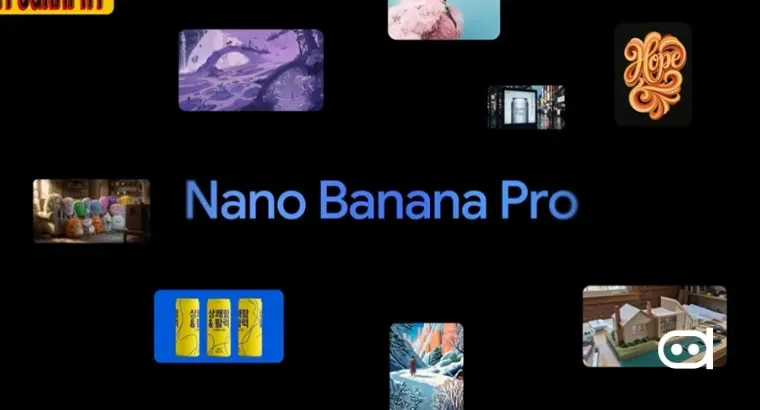
Google DeepMind has unveiled its most advanced AI image generation model to date, Gemini 3 Pro Image, popularly dubbed Nano Banana Pro. This multimodal model has impressed developers and enterprise engineers alike with its ability to produce infographics and complex diagrams from simple paragraph prompts, restoring logos from fragments and rendering text with exceptional clarity and accuracy.
Designed for Enterprise-Grade Multimodal Reasoning and Integration
Unlike earlier image generation tools primarily targeted at casual or artistic uses, Gemini 3 Pro Image is engineered for structured workflows requiring high resolution, multilingual support, and real-time knowledge grounding. It integrates seamlessly within Google’s broader AI infrastructure, powering services such as Gemini API, Vertex AI, Google Workspace applications, Google Ads, and Google AI Studio.
The model leverages the reasoning capabilities of Gemini 3 Pro to generate visuals that convey clear structure and factual intent. It can create user experience flows, educational diagrams, storyboards, and mockups from language prompts and combine up to 14 source images while maintaining consistent layout and identity fidelity.
Additionally, Google’s new AI development platform Antigravity employs Gemini 3 Pro Image to generate dynamic UI prototypes with fully rendered image assets before any code is written, demonstrating the model’s role as a foundational element in Google’s AI ecosystem.
High-Resolution Outputs with Localization and Real-Time Grounding
Gemini 3 Pro Image supports output resolutions up to 4K and offers fine-grained studio controls such as camera angle, color grading, focus, and lighting adjustments. It excels in multilingual prompt handling, semantic localization, and in-image text translation, enabling practical applications including:
- Translating packaging and signage while preserving layout integrity
- Localizing user interface mockups for regional markets
- Generating consistent advertising variants tailored for different locales
Users have already applied the model in diverse scenarios, from medical illustrations detailing CAR-T cell therapy to educational visuals explaining transformer models for non-specialists. The model also generates complex structured visuals such as restaurant menus, chalkboard lectures, and multi-character comic strips with coherent typography and layout continuity, all from single prompts.
Benchmarks Confirm Market-Leading Visual Quality and Accuracy
Independent evaluations from GenAI-Bench rank Gemini 3 Pro Image highest in overall user preference, visual quality, and infographic generation, outperforming competitors including OpenAI’s GPT-Image 1 and Seedream v4 as well as Google’s previous Gemini 2.5 Flash model. Google’s internal benchmarks further demonstrate reduced text error rates across languages and superior image editing fidelity.
The model’s strengths are especially evident in structured reasoning tasks, maintaining spatial consistency and context-aware detail across multiple panels—a critical requirement for enterprise documentation, training materials, and technical diagrams.
Pricing Reflects Premium Quality and Enterprise Features
Accessed via Gemini API and Google AI Studio, pricing for Gemini 3 Pro Image is tiered by resolution and usage. Input images cost approximately $0.067 each, with output images priced at $0.134 for 1K/2K resolution and $0.24 for 4K resolution. Text input and output tokens are charged at $2.00 and $12.00 per million tokens respectively, aligning with Gemini 3 Pro’s pricing model.
While these rates are higher than some competitors—such as OpenAI’s DALL-E 3 API, which charges around $0.04 per standard image—the enhanced resolution, enterprise-grade governance (notably, paid-tier images are excluded from Google’s model training), and integration with Google Cloud’s AI stack may justify the premium for businesses requiring robust scalability and compliance.
SynthID Watermarking Enhances AI Content Provenance and Compliance
Each image generated by Gemini 3 Pro Image includes SynthID, Google’s imperceptible digital watermarking system designed to improve provenance tracking and support regulatory governance. The updated Gemini app allows users to verify whether an image was AI-generated by Google, addressing growing concerns in sectors like healthcare, education, and media.
SynthID facilitates asset differentiation, audit trails, and compliance logging within enterprise environments, reinforcing Google’s commitment to operational transparency and trustworthiness in AI-generated content.
Community Reactions Highlight Both Capabilities and Limitations
Early feedback from developers and domain experts has ranged from amazement to critical scrutiny. Immunologist Dr. Derya Unutmaz hailed the model’s medical illustration accuracy as “perfect,” while AI educator Dan Mac described the explanatory visuals as “unbelievable.” Designers and engineers have praised the model’s ability to flawlessly render long-form text and complex layouts.
However, AI researcher Lisan al Gaib highlighted that the model, despite its advanced visual reasoning, still struggles with logic-heavy tasks such as Sudoku puzzles, underscoring the persistent challenges of hallucination and non-AGI limitations in current AI systems.
Positioning Gemini 3 Pro Image as a Core AI Platform Primitive
Rather than a standalone product, Gemini 3 Pro Image functions as a fundamental multimodal primitive within Google’s AI ecosystem, analogous to text completion or speech recognition. It underpins a wide range of enterprise applications—from automated onboarding materials to localized marketing collateral—enabling scalable, consistent, and programmatic visual asset creation.
As competition intensifies among leading AI companies like OpenAI, Google, and xAI, the release of Nano Banana Pro signals Google’s strategic vision that generative AI’s future will be as much visual as it is textual or spoken.

Related Articles
 Physicists reveal a new quantum state where electrons run wild
 The AI Automation Revolution: Why Most Jobs Are Doomed and No One Wants to Admit It
 North Korean Hackers Linked to $290 Million Cryptocurrency Theft, Raising AI Cybersecurity Concerns
 Google Unveils Nano Banana Pro: Advancing 4K AI Image Generation with Gemini 3 Pro Technology