
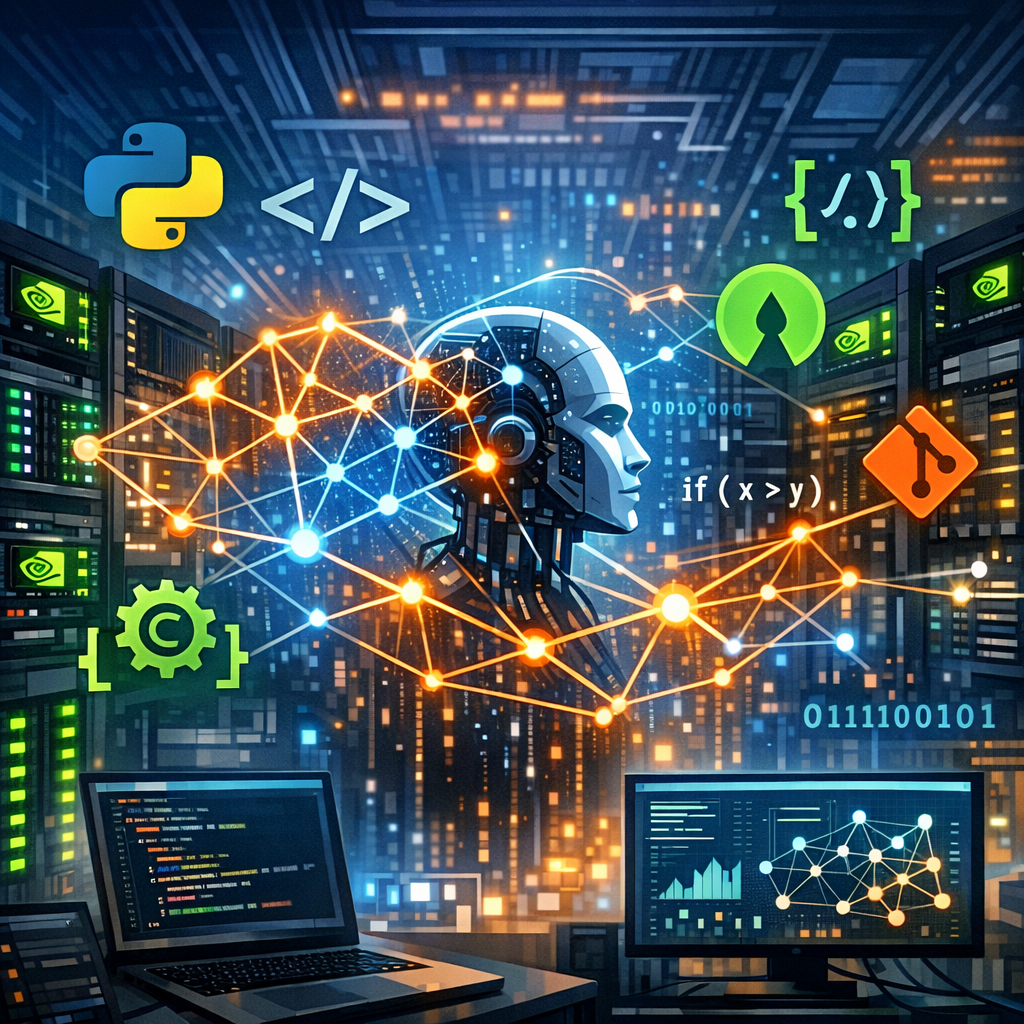
Nous Research, an open-source artificial intelligence startup backed by cryptocurrency-focused venture capital firm Paradigm, introduced a new AI model called NousCoder-14B designed for competitive programming. The model, trained over just four days using 48 Nvidia B200 GPUs, claims to match or surpass the performance of several larger proprietary AI coding systems.
This release comes at a moment of intense interest in AI-assisted software development, coinciding with the popularity of Anthropic’s Claude Code, which has gained widespread attention on social media for its advanced programming capabilities. The simultaneous emergence of these models highlights the accelerating pace of AI innovation and the fierce competition among companies to dominate software creation technologies.
Performance and Benchmarking
NousCoder-14B achieved a 67.87% accuracy rate on the LiveCodeBench v6 benchmark, which tests solutions on competitive programming problems released between August 2024 and May 2025. This represents a significant 7.08 percentage point improvement over the base model it was derived from, Alibaba’s Qwen3-14B, according to a detailed technical report published by Nous Research.
The model’s performance was contrasted with the rapid problem-solving feats of Claude Code, famously demonstrated by a Google engineer who showcased how Claude Code generated in an hour a complex distributed system that took her team a year to develop. This juxtaposition illustrates the different approaches: Anthropic emphasizes end-to-end software generation, while Nous Research focuses on open-source transparency and verifiable problem-solving.
Open-Source Commitment and Replicability
Setting itself apart from many competitors, Nous Research has released not only the model weights but also the entire reinforcement learning environment, benchmark suite, and training infrastructure through its Atropos framework. This transparency allows researchers with sufficient computing resources to reproduce or extend the model’s training process.
Joe Li, a former competitive programmer and researcher at Nous Research, led the training efforts. Li shared that the model’s learning curve mirrors his own progress on the Codeforces platform, where participants earn ratings based on competitive programming contests. While Li’s personal improvement from a 1600-1750 rating to 2100-2200 took nearly two years, the model achieved comparable gains in just four days, albeit requiring 24,000 solved problems compared to Li’s 1,000 — underscoring current AI inefficiencies in sample learning compared to humans.
Advanced Reinforcement Learning Techniques
NousCoder-14B leverages a reinforcement learning system based on “verifiable rewards,” providing binary feedback after executing generated code against test cases. The training involves running thousands of problems in parallel using Modal’s cloud platform, ensuring each code solution meets strict time and memory constraints.
The training process employed Dynamic Sampling Policy Optimization (DAPO), which improves learning by discarding problems that are either too easy or too difficult for the model. Additionally, the researchers used “iterative context extension,” progressively increasing the context window size during training and evaluation to enhance model accuracy.
Crucially, the training pipeline overlaps code generation with verification, maximizing GPU cluster utilization by asynchronously processing multiple model instances.
Data Limitations and Future Challenges
Nous Research’s report highlights a looming challenge: the dataset used contains a substantial portion of all publicly available, verifiable competitive programming problems in a standardized format — roughly 24,000 problems. This suggests that the model’s domain is nearing a data ceiling, which could slow future progress.
The scarcity of high-quality training data is a broader concern across AI development. Unlike natural language tasks that can rely on proxy metrics or human evaluation, code correctness is binary and must be verifiable, making synthetic data generation more complex. Joe Li suggests that future research may focus on generating solvable programming problems through self-play mechanisms to overcome data limitations.
Funding and Position in the AI Landscape
Nous Research has distinguished itself by focusing on open-source AI models that compete with proprietary alternatives. In April 2025, the company secured a $50 million investment round led by Paradigm, bringing total funding to approximately $65 million. This funding supports their decentralized AI training platform, Psyche, and reflects growing interest in open, transparent AI development.
Previous releases from Nous Research include Hermes 4, models noted for outperforming ChatGPT without content restrictions, and DeepHermes-3, which introduced a “toggle-on reasoning” feature to enable extended cognitive capabilities on demand.
Despite some skepticism about their unconventional branding and benchmarking practices, Nous Research continues to push the boundaries of open AI coding tools. Some industry voices have debated the relative performance of NousCoder-14B compared to competitors and questioned whether it is optimized for iterative coding workflows or single-shot problem solving.
Future Directions for AI Coding Research
The team identifies multi-turn reinforcement learning as a critical next step, where models would incorporate intermediate feedback such as compilation errors and incorrect outputs during multiple solution attempts, improving accuracy beyond the current binary pass/fail system.
Controlling the length of generated code remains a challenge, as incorrect solutions tend to be longer and exhaust context windows quickly. Additionally, problem generation combined with self-play is proposed as a promising avenue to expand training data and enhance model creativity.
NousCoder-14B is available under an Apache 2.0 license on Hugging Face, with the complete Atropos training stack published for community use.
What took human effort spanning years to achieve, these AI systems can now replicate in days, albeit with much larger problem exposure. Soon, such models might autonomously generate training problems and surpass human benchmarks, signaling a transformative future where AI not only learns to code but also becomes an even better teacher than humans.
Fonte: ver artigo original

Related Articles
 DeepMind Recommends AI Assign Humans Occasional Busywork to Maintain Job Skills
 Anthropic Inadvertently Exposes Claude Code Source Code to Public
 European Commission Launches Antitrust Investigation into Meta’s WhatsApp AI Policy
 India’s Spinny Secures $160M Funding Round to Acquire GoMechanic, Valuation Nears $1.8 Billion



