
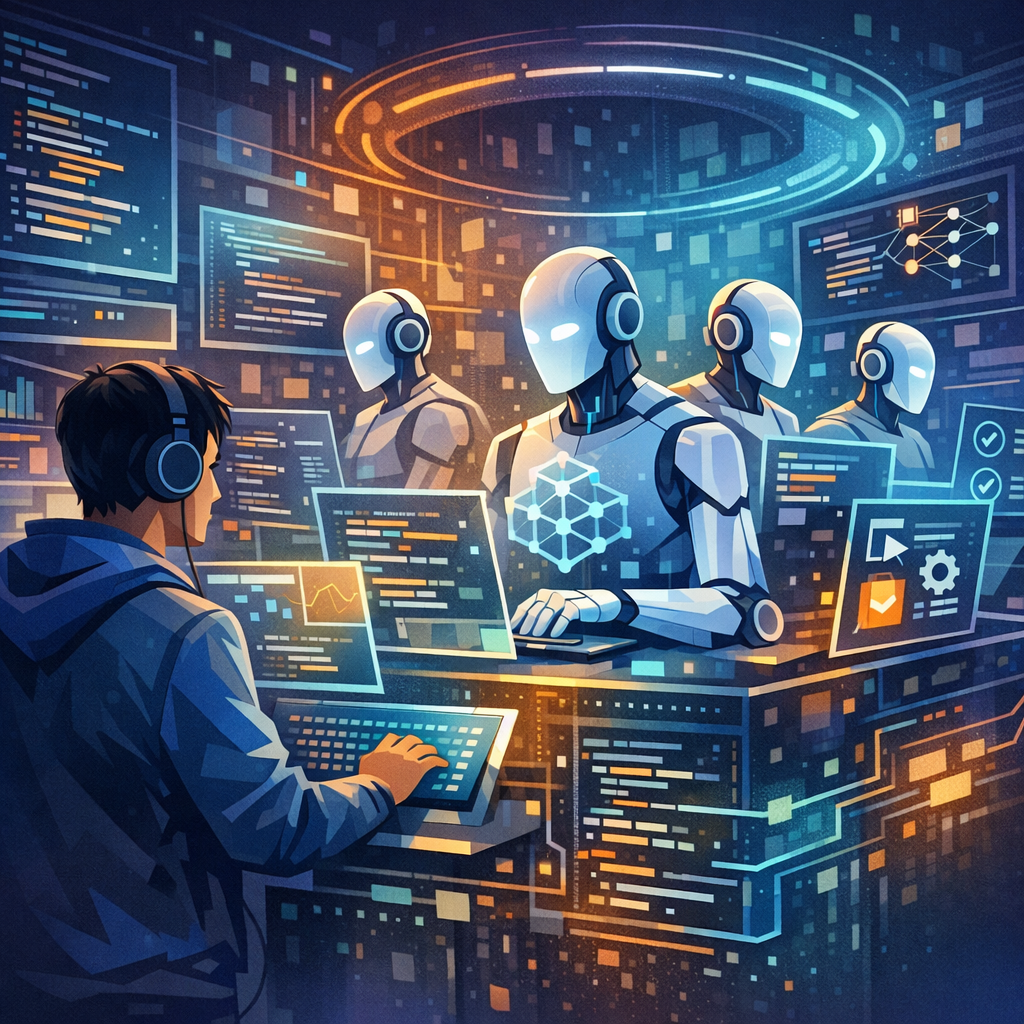
In a significant development that has electrified the software engineering community, Boris Cherny, the creator and head of Claude Code at Anthropic, has shared his innovative coding workflow that leverages multiple AI agents to enhance productivity. This revelation, initially posted as a thread on X, has quickly become a focal point for discussions about the future of software development.
Multiplying Developer Output Through Parallel AI Agents
Cherny’s approach diverges from traditional linear coding methods. Rather than focusing on one task at a time, he operates as a commander managing five Claude AI agents concurrently within his terminal. Each agent handles distinct tasks such as running test suites, refactoring legacy code, or drafting documentation. This multitasking is facilitated by iTerm2 system notifications, which alert him when any AI agent requires input.
Additionally, Cherny manages up to ten agents via the claude.ai web interface, using a “teleport” command to seamlessly transition sessions between the browser and his local machine. This method exemplifies Anthropic’s “do more with less” strategy, emphasizing efficient orchestration over massive infrastructure expansion.
Choosing Intelligence Over Speed: The Opus 4.5 Model
Contrary to industry trends favoring faster AI models, Cherny exclusively employs Anthropic’s heaviest and slowest model, Opus 4.5. He explains that despite its slower token generation, Opus 4.5 requires less human correction due to its superior coding accuracy and tool usage, resulting in overall faster and higher-quality output.
This insight highlights a crucial enterprise technology consideration: reducing the human effort spent on fixing AI mistakes can be more valuable than optimizing raw generation speed, effectively shifting the cost from computational resources to human time savings.
Creating a Self-Learning AI Ecosystem with CLAUDE.md
To counteract the common limitation of AI’s “memory loss” between sessions, Cherny’s team maintains a shared file named CLAUDE.md in their git repository. This file documents every AI error encountered, serving as a reference that instructs Claude agents to avoid repeating mistakes in future interactions.
This practice transforms the codebase into a dynamic, self-correcting system. Human developers not only fix issues but also update AI guidelines, effectively making each error a new rule that enhances the AI’s intelligence over time.
Automating Tedious Tasks with Slash Commands and Subagents
Cherny’s workflow also incorporates automation to streamline mundane development tasks. He utilizes slash commands—custom shortcuts embedded in the project repository—to execute complex operations like committing code, pushing changes, and opening pull requests with a single command.
Moreover, specialized AI subagents manage specific development phases, such as simplifying code architecture and performing end-to-end application tests before deployment, further reducing manual workload.
Verification Loops: The Key to Reliable AI-Generated Code
A pivotal feature of Claude Code’s success is its built-in verification loop. Unlike typical AI code generators, Claude not only writes code but also tests it autonomously using browser automation and test suites. Cherny emphasizes that this iterative testing process improves code quality by two to three times, ensuring that the AI delivers functional and user-friendly software.
Implications for the Future of Software Engineering
The enthusiastic response to Cherny’s workflow indicates a transformative moment for developers worldwide. Traditional AI coding tools have been viewed as enhanced autocomplete assistants, but Claude Code’s method demonstrates AI’s potential as an integrated workforce multiplier.
As noted by prominent developer Jeff Tang, embracing this approach can significantly amplify a programmer’s capabilities, effectively changing the game from manual coding to directing autonomous AI teams. The challenge for developers moving forward will be to adapt their mindset from using AI as a helper to managing it as a collaborative labor force.
With Claude Code reportedly surpassing $1 billion in annual recurring revenue, Anthropic’s advancements underline a broader trend in AI-driven productivity gains across industries, signaling a new era where human and artificial intelligence work in tandem to build software faster and smarter.
Fonte: ver artigo original

Related Articles
 Lambda Secures $1.5 Billion Funding Following Major Microsoft Partnership
 AI Business Reality: Essential Insights for Enterprise Leaders in 2025
 Insurance Leader AIG Accelerates Efficiency with Agentic AI and Orchestration Layer
 Agentic AI Set to Transform Healthcare Marketing with $450 Billion Economic Impact by 2028



