Salesforce Introduces Advanced AI Monitoring to Demystify Autonomous Agent Behavior
On Thursday, Salesforce announced the release of Agentforce Observability, a comprehensive suite of tools integrated within its Agentforce 360 Platform aimed at solving a persistent challenge in corporate AI deployments: the lack of transparency in how AI agents arrive at decisions during live customer interactions.
These new capabilities offer organizations granular, near-real-time visibility into every action, decision step, and safety guardrail triggered by their AI agents. This initiative comes amid a surge in AI adoption by enterprises, which demand greater oversight to confidently scale autonomous systems that promise efficiency but pose risks due to their opaque decision-making processes.
“You can’t scale what you can’t see,” stated Adam Evans, Executive Vice President and General Manager of Salesforce AI. He highlighted that AI implementations have increased by 282% recently, underscoring the urgent need for robust observability to monitor complex fleets of AI agents operating across business functions.
Addressing the ‘Black Box’ Problem in AI Agent Deployments
Despite AI agents effectively handling tasks such as resolving customer queries or scheduling appointments, companies often remain in the dark about the reasoning paths behind those outcomes. This opacity complicates troubleshooting and risk management, especially when agents encounter unusual scenarios or errors.
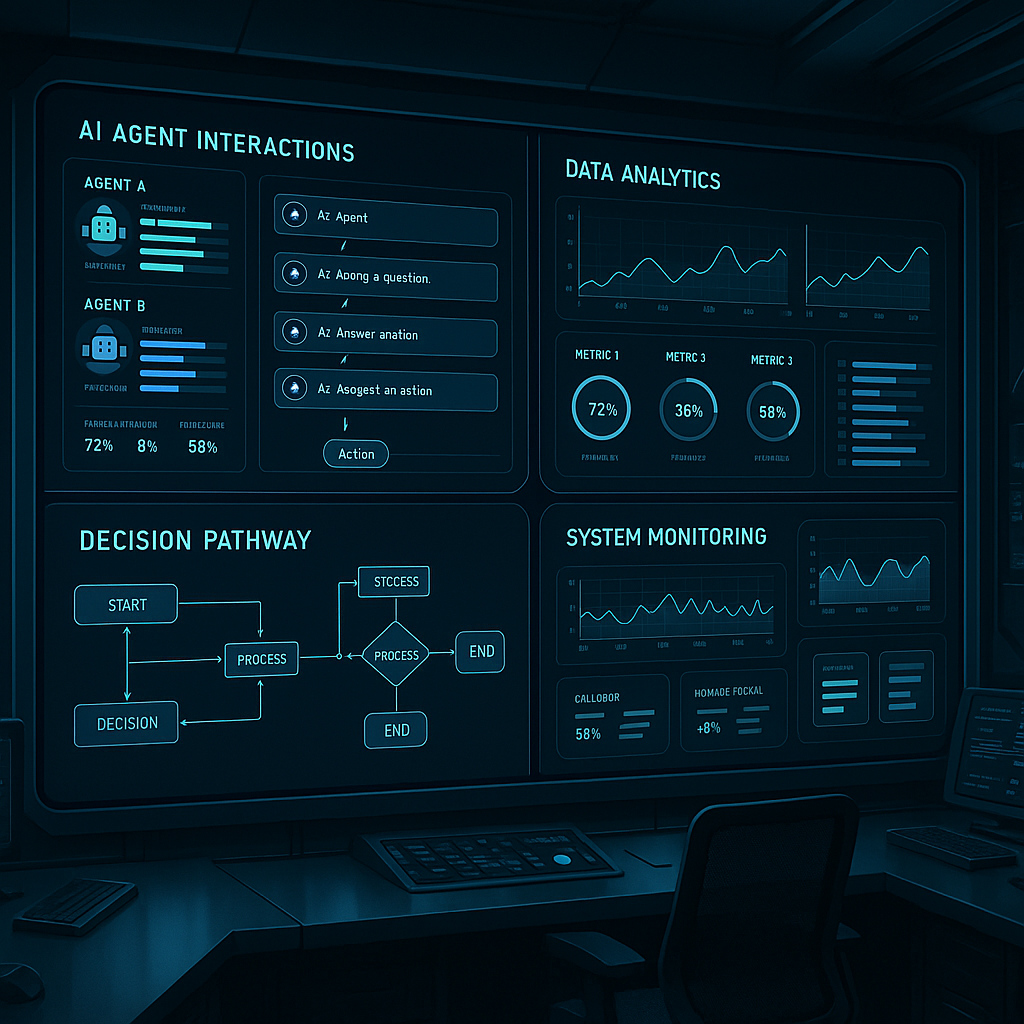
Gary Lerhaupt, Vice President of Salesforce AI and lead for the observability initiative, described Agentforce Observability as “a mission control system” that not only monitors but also analyzes and optimizes AI agent performance. Unlike traditional monitoring tools, it delivers business-specific metrics—ranging from customer engagement rates in service to lead conversion statistics in sales—that provide actionable insights.
Real-World Impact: Success Stories from 1-800Accountant and Reddit
Early adopters have reported significant benefits. Ryan Teeples, CTO of 1-800Accountant, explained how the company deployed Agentforce AI agents to manage complex tax inquiries and appointment scheduling around the clock. The AI integrates data from audit logs, customer histories, and IRS publications to offer immediate, autonomous responses.
“Given the sensitivity of tax information and the rapid pace during tax season, Observability provides us with full trust and transparency over every agent interaction in one unified platform,” Teeples emphasized. The system’s optimization features exposed previously hidden performance gaps and facilitated swift issue resolution by enabling the configuration of precise guardrails.
Within just 24 hours, Agentforce handled over 1,000 client engagements at 1-800Accountant. The company anticipates supporting a 40% increase in client volume this year without expanding seasonal staff, while allowing CPAs to dedicate 50% more time to complex advisory roles.
Similarly, Reddit has leveraged Agentforce Observability for advertiser support, achieving a 46% deflection rate on support cases. John Thompson, Vice President of Sales Strategy and Operations at Reddit, noted, “Observing every interaction helps us understand how our AI guides advertisers through complex workflows, providing clarity not only on issue resolution but also on the decision-making process itself.”
Technical Foundations: Session Tracing and Unified Agent Management
Salesforce’s observability framework is underpinned by two key components. The Session Tracing Data Model meticulously logs user inputs, AI responses, reasoning processes, language model calls, and guardrail triggers, storing this information securely within the Data 360 platform to create unified session-level visibility.
Complementing this, MuleSoft Agent Fabric tackles the challenge of agent sprawl by offering a consolidated dashboard that visualizes a company’s entire AI agent network—including third-party agents—enabling holistic monitoring and management from a single interface.
The observability suite is organized into three core functional modules:
- Agent Analytics: Tracks performance indicators, uncovers trends, and flags ineffective behaviors.
- Agent Optimization: Provides end-to-end interaction visibility, groups similar requests to identify patterns, and detects configuration issues.
- Agent Health Monitoring: (Launching Spring 2026) Monitors critical health metrics in near real-time and alerts on errors and latency spikes.
Pierre Matuchet, Senior VP of IT and Digital Transformation at Adecco, shared that early testing revealed the agent’s ability to handle unexpected user behaviors responsibly, bolstering confidence prior to full deployment.
Competitive Edge Over Microsoft, Google, and AWS
By embedding observability as a standard feature at no additional cost, Salesforce positions Agentforce Observability as a more comprehensive solution than the basic monitoring tools offered by major cloud providers like Microsoft, Google, and Amazon Web Services.
Lerhaupt asserted, “Our tools capture the full telemetry and reasoning behind every AI agent interaction, enabling deep analysis and session quality scoring that empower customers to optimize their AI deployments effectively.” This depth of insight stands in contrast to the broader but shallower monitoring capabilities typical of native cloud offerings.
Scaling AI from Pilots to Production: Evidence of Growing Enterprise Adoption
Salesforce reports over 12,000 customers across 39 countries actively using Agentforce, collectively managing 1.2 billion AI-driven workflows. While the company did not provide a detailed split between pilot projects and production workloads, customer examples illustrate a progression from trust-building and design (Day 0 and Day 1) to scaling successful deployments enterprise-wide (Day 2).
The economic pressures to reduce labor costs while maintaining service quality are driving accelerated AI adoption. However, enterprises require trustworthy AI agents to realize these efficiencies, making observability tools crucial to enabling widespread deployment.
Beyond Deployment: The Critical Role of Continuous Monitoring
Salesforce emphasizes that AI agent management extends well beyond initial development and deployment. AI agents operate on probabilistic models and adapt over time, making ongoing transparency into their behavior essential to detect drift, uncover failure modes, and optimize user experiences.
“Building an agent is just the beginning,” Lerhaupt noted. “Understanding the ‘why’ behind AI decisions is vital for trust and continuous improvement.”
For example, 1-800Accountant plans to expand integrations, such as Slack workflows and conversational analytics, relying on the confidence that Agentforce Observability delivers.
Trust as the Key Barrier to AI Agent Scaling
Interviews with customers consistently highlight trust as the pivotal factor limiting broader AI agent deployment. Despite technological readiness, executives hesitate to scale autonomous systems without clear visibility into their decision-making.
Salesforce is positioning Agentforce Observability not merely as a monitoring solution but as a management layer analogous to human workforce supervision—providing granular oversight, feedback, and optimization capabilities.
This approach leverages the unique advantage of AI agents: the ability to log and analyze every decision and reasoning step with unparalleled granularity, enabling continuous performance enhancement.
As enterprises race to integrate AI at scale, those equipped with transparent observability tools will likely outpace competitors constrained by uncertainty. In this evolving landscape, observability is not optional but fundamental to transitioning from tentative experimentation to confident, enterprise-wide AI adoption.

Related Articles
 OpenAI Announces Upcoming Enhanced Version of Its Olympic Math Gold Model
 AI Startup Founder Plans ‘March for Billionaires’ Against California Wealth Tax
 Meta and Google Face Legal Challenge Over Instagram and YouTube’s Impact on Minors’ Mental Health
 OpenAI Launches LifeSciBench to Benchmark AI in Life Sciences Research



