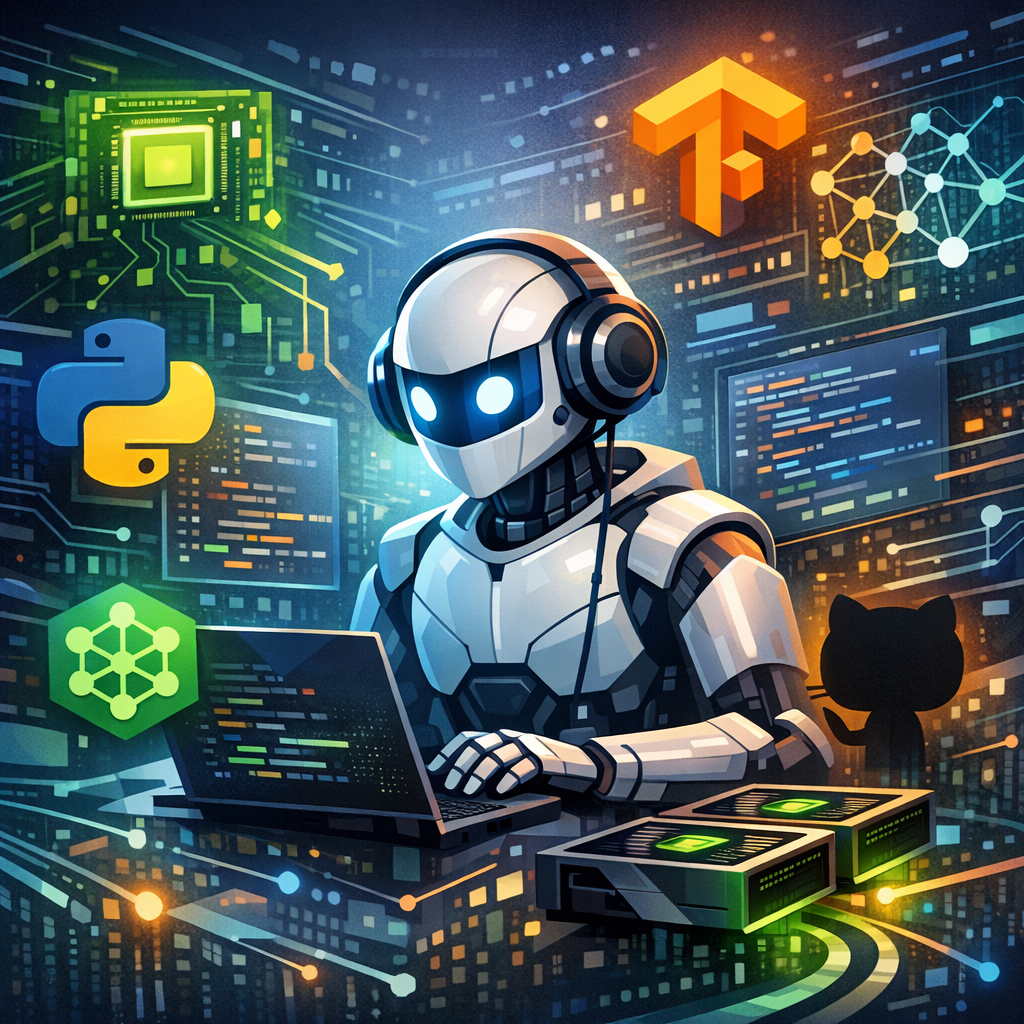
Nous Research, an open-source artificial intelligence startup backed by the crypto venture capital firm Paradigm, announced the release of its new AI coding model, NousCoder-14B. The model, designed for competitive programming tasks, reportedly matches or surpasses several larger proprietary systems and was trained in just four days using 48 of Nvidia’s latest B200 graphics processors.
This launch arrives amidst heightened attention on AI-assisted programming tools, notably following the significant buzz around Anthropic’s Claude Code, an agentic programming assistant that has gained widespread developer acclaim since early 2025. The simultaneous emergence of NousCoder-14B highlights the rapid evolution of AI software development and the intense competition among companies to lead in this transformative technology.
Performance and Technical Achievements of NousCoder-14B
NousCoder-14B achieved a 67.87 percent accuracy on the LiveCodeBench v6 benchmark, which evaluates AI models on competitive programming problems released between August 2024 and May 2025. This represents an improvement of over seven percentage points compared to its base model, Alibaba’s Qwen3-14B, according to Nous Research’s accompanying technical report.
Highlighting the current landscape, Jaana Dogan, a principal engineer at Google, shared on social media how Claude Code was able to replicate a system her team developed over a year, within an hour, illustrating the power and growing expectations of AI coding tools.
Commitment to Openness and Reproducibility
Unlike many proprietary competitors, Nous Research emphasized transparency by open-sourcing not only the model weights of NousCoder-14B but also the entire reinforcement learning environment, benchmarking suite, and training framework—built on their Atropos platform. This openness enables researchers with sufficient computing resources to reproduce or extend the model’s capabilities, fostering collaborative advancement in AI coding research.
The model was trained by Joe Li, a former competitive programmer, who noted that NousCoder-14B’s improvement in performance mirrors his personal progress on competitive programming platforms, but achieved in a fraction of the time. While Li advanced over nearly two years by solving around 1,000 problems, the AI model required roughly 24,000 problems to reach comparable skill levels, highlighting current differences in sample efficiency between humans and AI.
Advanced Training Techniques and Infrastructure
NousCoder-14B was developed using reinforcement learning with verifiable rewards, where the model generates code solutions that are then tested against predefined test cases, receiving binary feedback of correct or incorrect. This process requires robust infrastructure, and Nous Research utilized Modal’s cloud platform to execute sandboxed code in parallel across thousands of problems.
The training employed Dynamic Sampling Policy Optimization (DAPO), which optimizes learning by focusing on informative problem examples and discarding those too easy or too difficult for the model. Additionally, iterative context extension techniques expanded the model’s token window during training and evaluation, enhancing its reasoning capacity and final accuracy.
Efficient hardware utilization was achieved through overlapping inference and verification steps, allowing multiple instances of the model to work asynchronously on different problems, maximizing performance on expensive GPU clusters.
Challenges Ahead: Data Scarcity and Future Directions
A critical insight from the technical report is the near exhaustion of high-quality training data for competitive programming AI models. The dataset used includes approximately 24,000 verifiable problems, representing a significant portion of all such problems publicly available in standardized formats. This data limitation poses challenges for future model improvements.
Researchers emphasize the need for advances in synthetic data generation and data-efficient algorithms to overcome this bottleneck. One promising approach involves training models not only to solve programming problems but also to generate solvable problems themselves, enabling a form of self-play similar to strategies successful in game-playing AI.
Strategic Positioning and Industry Impact
Nous Research has positioned itself as a distinctive player in AI by focusing on open-source models that compete with proprietary systems. The company recently raised $50 million in funding led by Paradigm, bringing its total to $65 million, signaling strong investor confidence in decentralized AI training methodologies.
Previous releases include Hermes 4 and DeepHermes-3, noted for outperforming ChatGPT in some benchmarks and introducing user-controllable reasoning capabilities. While the company’s anime-inspired branding has attracted some skepticism, its technical contributions and openness are gaining recognition within the AI research community.
Looking Forward: Enhancing AI Coding Tools
Future research directions highlighted by Nous Research include developing multi-turn reinforcement learning approaches that leverage intermediate feedback from test cases, addressing challenges in controlling solution length, and advancing creative problem generation through AI. These efforts aim to enhance the practical utility and efficiency of AI coding assistants.
Available now under an Apache 2.0 license on Hugging Face, NousCoder-14B and the fully open Atropos training stack offer a valuable resource for developers and researchers to build upon. As AI systems increasingly approach and potentially surpass human performance benchmarks, the focus is shifting to how these models can become effective teachers and innovators in software development.
Fonte: ver artigo original

Related Articles
 Focus Friend by Hank Green Wins Google Play’s App of the Year Amid AI Boom
 Meta to Disable Accounts of Australian Teens Under 16 Starting December 10
 China Deploys AI to Map Entire Renewable Energy Grid, Setting a Global Benchmark
 Google Maps Enhances User Experience with Gemini-Powered Tips and EV Charger Predictions