When Boris Cherny, creator and head of Claude Code at Anthropic, shared his personal terminal workflow, the developer community responded with unprecedented enthusiasm. What started as a simple explanation of his coding setup quickly became a viral discussion about the future of software development and the transformative role of AI in the field.
Industry experts hailed Cherny’s approach as a game-changer. Jeff Tang, a prominent developer voice, emphasized that ignoring these best practices means falling behind, while Kyle McNease speculated that Anthropic could be experiencing its own “ChatGPT moment.” The core excitement lies in Cherny’s ability to leverage AI to operate with the efficiency of an entire engineering team, fundamentally changing how coding is performed.
Orchestrating AI Agents: Coding as a Real-Time Strategy Game
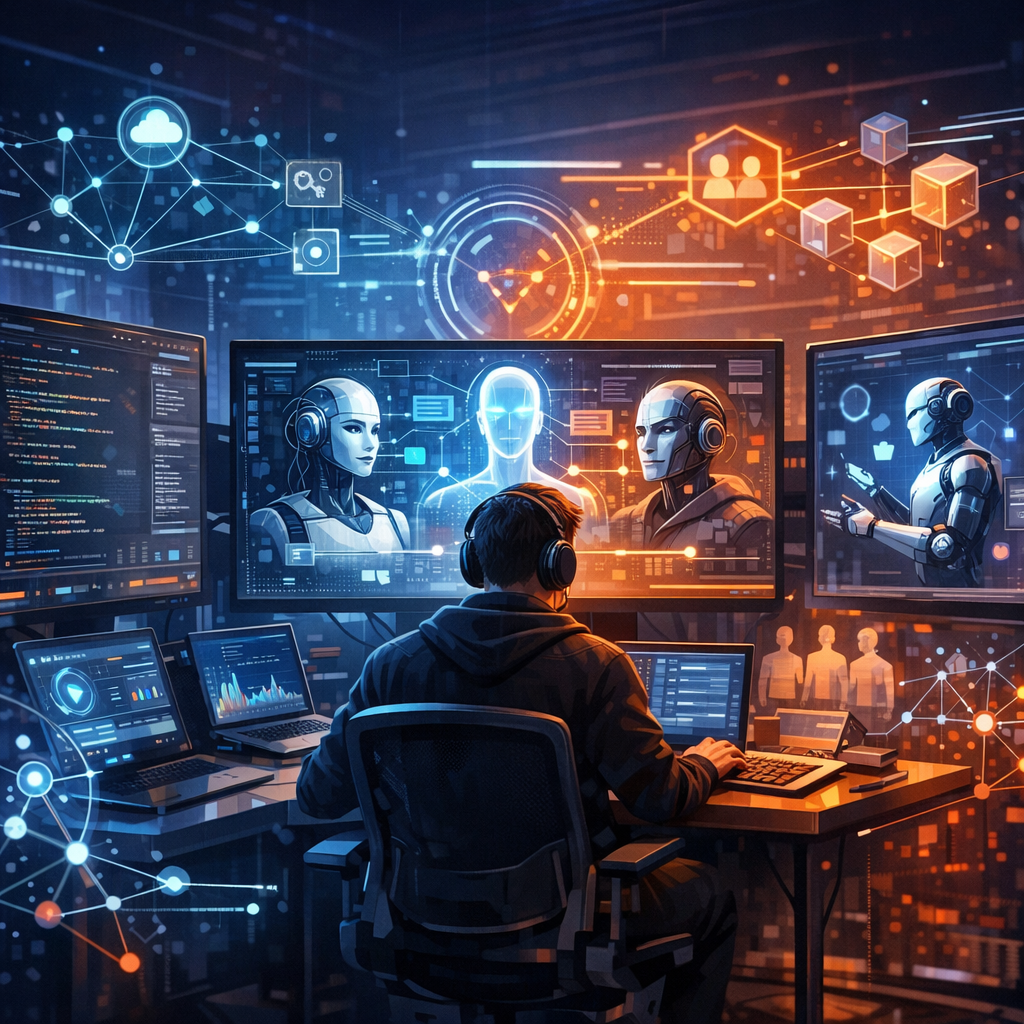
At the heart of Cherny’s workflow is a non-linear approach to programming. Instead of sequentially writing and testing code, Cherny acts like a “fleet commander,” simultaneously managing five Claude AI agents within his terminal. Numbered tabs and system notifications enable him to monitor and interact with these agents efficiently.
Each AI agent handles distinct tasks: running test suites, refactoring legacy code, drafting documentation, and more. Additionally, Cherny runs multiple Claude sessions in his browser, using a “teleport” command to seamlessly transfer sessions between his local machine and the web interface. This multi-agent orchestration exemplifies Anthropic’s “do more with less” philosophy, focusing on smarter model utilization rather than massive infrastructure expansion.
Choosing Intelligence Over Speed: The Power of Opus 4.5
Contrary to industry trends prioritizing speed, Cherny exclusively employs Anthropic’s most advanced and slowest model, Opus 4.5. Despite its slower generation times, Opus 4.5 requires less human steering and excels at tool integration, ultimately delivering faster overall results by reducing correction time.
This insight highlights a critical bottleneck in AI-assisted coding: human effort spent fixing AI errors. By investing in smarter models upfront, developers can minimize time-consuming corrections, leading to more efficient workflows.
Turning AI Mistakes Into Learning Opportunities
A significant challenge with AI coding assistants is their lack of long-term memory about a project’s unique style or architectural choices. Cherny’s team addresses this by maintaining a single file, CLAUDE.md, in their git repository. Whenever Claude makes an error, it is logged in this file to prevent repetition.
This approach transforms the codebase into a self-improving system. When human reviewers spot errors during pull requests, they not only correct the code but also update the AI’s instructions. As product leader Aakash Gupta notes, “Every mistake becomes a rule,” meaning the agent grows smarter and more aligned with the team’s standards over time.
Automating Tedious Tasks with Slash Commands and Subagents
Cherny enhances productivity further by using slash commands—custom shortcuts stored in the project’s repository—to automate complex operations with a single keystroke. One frequently used command, /commit-push-pr, automates the entire version control process, including committing code, pushing changes, and opening pull requests.
Moreover, Cherny deploys specialized AI subagents for distinct development phases, such as simplifying code architecture post-development and running end-to-end verification tests before deployment. These subagents reduce the manual workload and improve code quality.
Verification Loops: The Key to Reliable AI-Generated Code
A defining feature of Claude Code’s success is its integrated verification loop. Cherny explains that Claude tests every change using browser automation through the Claude Chrome extension, iterating until the code functions correctly and the user experience is smooth.
This self-testing capability significantly enhances output quality, improving it by two to three times compared to code generated without verification. By ensuring code correctness autonomously, Claude transcends the role of a mere text generator and becomes an active tester.
The Future of Software Engineering: Rethinking AI as Workforce
Cherny’s workflow signals a profound shift in software development. For years, AI coding tools were viewed as mere autocomplete aids. Today, they are evolving into operating systems that manage labor and multiply human productivity.
Jeff Tang summarizes the impact: “Read this if you’re already an engineer… and want more power.” The tools to quintuple developer output are available now, requiring only a mindset change—from seeing AI as a helper to treating it as a full-fledged workforce. Early adopters of this approach will not just be more productive; they will be playing an entirely different game, leaving traditional typing behind.
Fonte: ver artigo original

Related Articles
 Anthropic’s Cowork Desktop App Introduces Scheduled Tasks to Boost AI Assistant Productivity
 Deloitte Warns AI Agent Deployment Outpaces Safety and Governance Frameworks
 Apple Unveils STARFlow-V: A Novel Video Generation Model Using Normalizing Flows
 Life EV Acquires Rad Power Bikes, Ensuring Brand Continuity