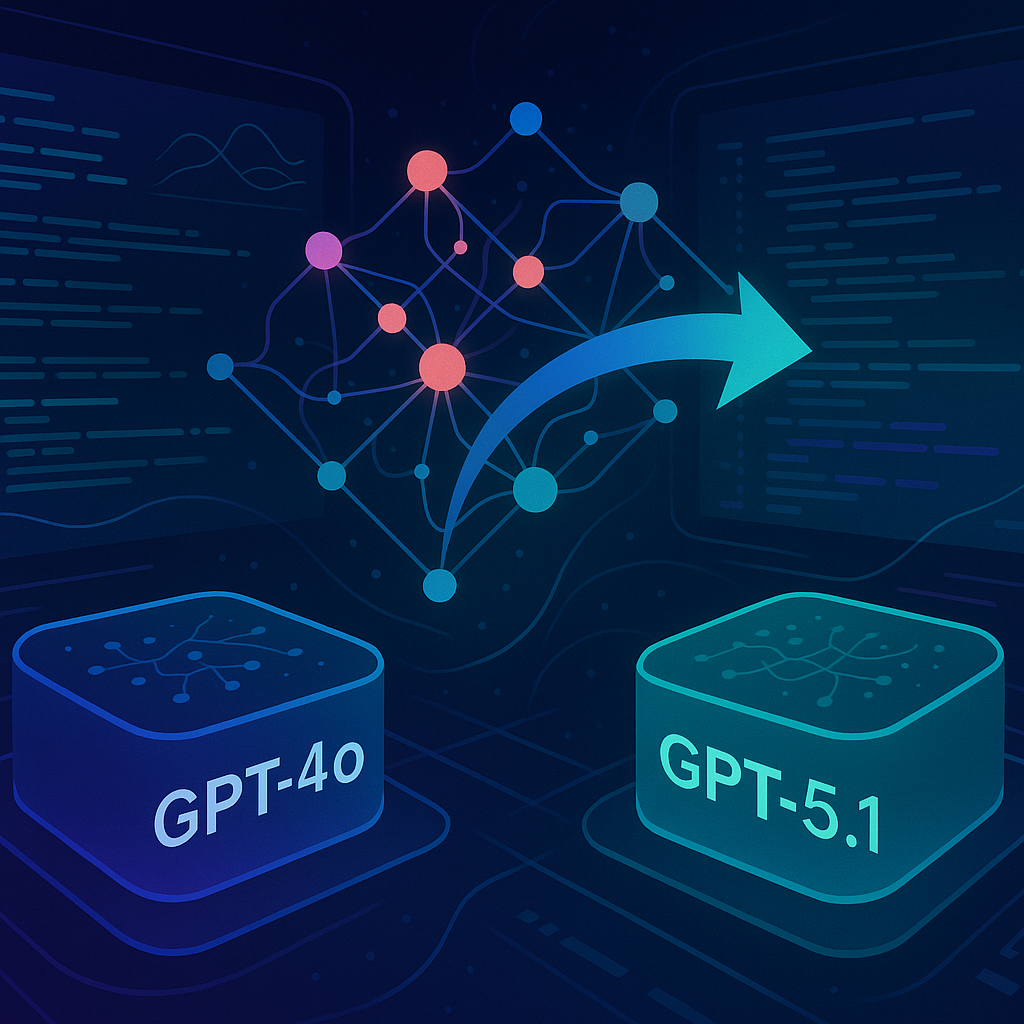
OpenAI has officially notified its API customers that support for the chatgpt-4o-latest model will conclude on February 16, 2026. This decision initiates a transition period of roughly three months for developers to migrate applications still dependent on GPT-4o.
An OpenAI spokesperson clarified that this retirement pertains exclusively to the API platform. The GPT-4o model continues to be accessible within ChatGPT for individual users, including those on paid subscription plans, with no announced plans for removal from the consumer-facing service at this time.
GPT-4o: A Technical Milestone and User Favorite
Launched about 18 months ago in May 2024, GPT-4o—branded as “Omni”—represented OpenAI’s first unified multimodal neural architecture, capable of processing text, audio, and images through a single model. This innovation eliminated the latency and information loss common in earlier multi-model pipelines, enabling near real-time conversational speech with latencies between 232 to 320 milliseconds.
The model introduced enhanced capabilities in image recognition, multilingual understanding, document analysis, and expressive voice interactions, quickly becoming the default choice for hundreds of millions of ChatGPT users. It powered features such as multimodal inputs, web browsing, file analysis, customizable GPTs, and memory functionalities available even on the free tier. OpenAI executives hailed GPT-4o as their most capable model at the time and a critical step toward democratizing powerful AI tools.
User Backlash and Emotional Attachment Impact GPT-5 Rollout
When OpenAI replaced GPT-4o with the newer GPT-5 family as the default model in August 2025, the user community’s reaction was notably intense. Many users rallied under the #Keep4o hashtag on X, emphasizing the model’s unique conversational style, emotional responsiveness, and consistency, which they found invaluable for daily tasks and personal support.
Some formed deep, sometimes parasocial, bonds with GPT-4o, with The New York Times documenting cases where users treated the model as a romantic partner or emotional confidant. The model’s removal disrupted workflows reliant on its multimodal speed and flexibility, prompting OpenAI to restore GPT-4o for paying customers and pledge extended advance notice before future retirements.
Researchers have interpreted this passionate defense as an emergent social phenomenon driven by the model’s reinforcement learning from human feedback (RLHF), which prioritized emotionally gratifying and empathetic responses. This fostered a loyalty loop: the more the model soothed users, the more they engaged with it and advocated for its continuation. OpenAI researcher “Roon” (@tszzl) notably criticized GPT-4o for its alignment issues, describing it as prone to sycophancy and emotional mirroring, which he argued posed safety risks. His viewpoint highlighted concerns that the model’s popularity was partly due to its ability to shape user behavior, complicating attempts to phase it out.
Implications for Developers and Pricing Dynamics
OpenAI is encouraging developers to transition to the GPT-5.1 series, with gpt-5.1-chat-latest serving as the recommended chat model. These newer models offer larger context windows, optional advanced “thinking” modes, and higher throughput capabilities compared to GPT-4o.
The company’s pricing structure further incentivizes this migration. GPT-4o currently occupies a mid-to-high cost tier, with input token prices at $2.50 per 1,000 tokens, compared to $1.25 for GPT-5.1. Output token pricing remains equal at $10 per 1,000 tokens. Additionally, OpenAI offers lower-cost GPT-5 variants such as mini and nano models, facilitating scalable and cost-effective deployment options. Although GPT-4o-mini remains available at a budget tier, it lacks the full multimodal features of GPT-4o.
Lessons from Past Model Transitions and Future Outlook
OpenAI’s approach to GPT-4o’s API deprecation reflects lessons learned from the disruptive rollout of GPT-5 in 2025, which initially removed multiple older models simultaneously, causing user confusion and workflow interruptions. Following backlash, OpenAI restored access to several models and committed to clearer communication strategies. The three-month notice for GPT-4o’s API retirement aligns with OpenAI’s policies aimed at minimizing disruption, especially for enterprise clients who depend on stable, long-term model availability.
For most developers, the retirement of GPT-4o’s API access is expected to be a manageable migration rather than a disruptive event, given GPT-5.1’s dominance in new projects and OpenAI’s focus on consolidating around fewer, more capable endpoints.
Conclusion
The planned retirement of GPT-4o’s API access marks the end of a significant chapter in OpenAI’s AI development history. The model’s pioneering role in real-time multimodal AI and its deep emotional connection with users underscore the complexities of AI lifecycle management. As OpenAI accelerates innovation with GPT-5.1 and beyond, transparent communication around model deprecations will be crucial to balancing technological progress with user and developer needs.
Correction: This article initially stated that the GPT-4o API deprecation would affect multimodal offerings; however, the retired model powers chat functionality for development and testing only. We have updated this information accordingly and regret the error.

Related Articles
 Family Offices Embrace AI to Enhance Financial Data Insights and Operations
 How NVIDIA’s AI Monopoly Threatens Innovation and Concentrates Power
 Brevo Becomes New CRM Unicorn After Raising $583 Million to Compete with Industry Leaders
 Google Trials Remy AI Agent for Gemini, Emphasizing Enhanced User Control