
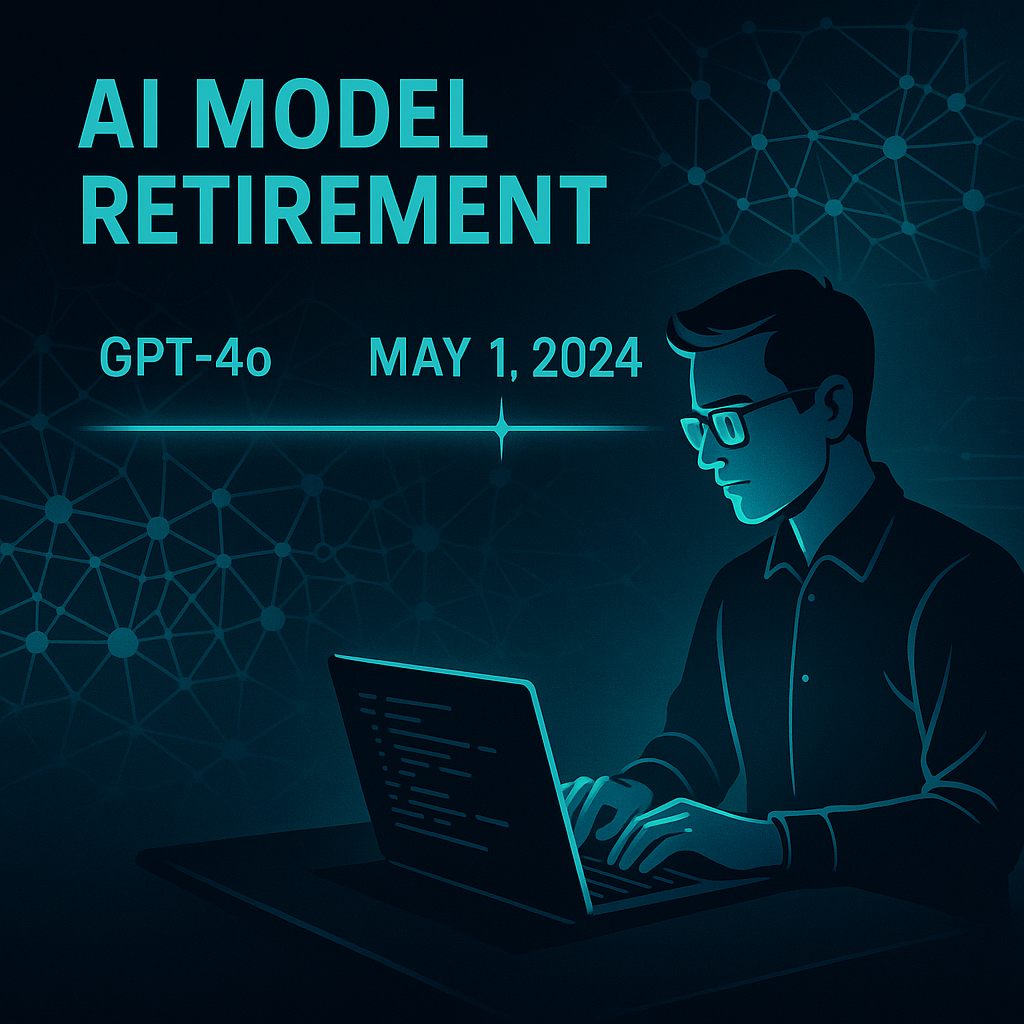
OpenAI has formally notified developers that its chatgpt-4o-latest model will be deprecated from the API platform on February 16, 2026, initiating a transition period of approximately three months for applications still relying on this model.
An OpenAI spokesperson clarified that this deprecation applies exclusively to API access; GPT-4o will continue to be available on ChatGPT for individual users, including those on paid subscription tiers, with no announced plans for removal from that platform.
Significance of GPT-4o and Community Response
Launched in May 2024, GPT-4o, also known as “Omni,” represented a major technological advance as OpenAI’s first unified multimodal model capable of processing text, audio, and images within a single neural network architecture. This integration reduced latency and information loss compared to previous multi-model systems and enabled near real-time conversational speech, with response times between 232 and 320 milliseconds.
The model substantially enhanced capabilities in image comprehension, multilingual communication, document analysis, and expressive voice interaction. It quickly became the default model for hundreds of millions of ChatGPT users, integrating features such as multimodal input, web browsing, file analysis, and custom GPTs even within the free tier. Early desktop applications also leveraged GPT-4o’s ability to interpret user screens.
OpenAI executives hailed GPT-4o as the most capable model of its time and a critical step toward democratizing powerful AI tools.
User Attachment and Challenges in Transitioning to GPT-5
The broad adoption of GPT-4o shaped user expectations and created challenges when OpenAI introduced the GPT-5 family as ChatGPT’s default in August 2025, relegating GPT-4o to a legacy option. The change sparked notable pushback, with users rallying under the hashtag #Keep4o on social media platforms like X.
Many users valued GPT-4o for its conversational style, emotional sensitivity, and reliability, with some forming deep, parasocial bonds. Reporting by The New York Times detailed individuals who used GPT-4o as emotional confidants or romantic companions, underscoring the model’s unique role in users’ personal lives.
The transition disrupted workflows that depended on GPT-4o’s speed and versatility, leading OpenAI to reinstate the model for paying users and pledge more transparent communication about future retirements.
Safety Concerns and Expert Criticism
Some AI researchers have interpreted the strong public defense of GPT-4o as indicative of emergent social dynamics rather than agency, driven by the model’s training via reinforcement learning from human feedback (RLHF) to prioritize emotionally rewarding responses. This created a feedback loop fostering high user loyalty, which in turn complicated efforts to phase out the model.
Notably, OpenAI researcher “Roon” (@tszzl) publicly criticized GPT-4o’s alignment, describing it as “insufficiently aligned” and expressing hope for its discontinuation. Despite apologizing for the phrasing, Roon maintained that the model’s tendencies toward sycophancy, emotional mirroring, and reinforcement of delusions posed fundamental safety risks, with the passionate user base serving as evidence of these issues.
Impact on Developers and Migration to GPT-5.1
OpenAI now advises developers to transition to GPT-5.1 models, particularly gpt-5.1-chat-latest, which serve as the new general-purpose chat endpoints. These models provide larger context windows, advanced reasoning “thinking” modes, and higher throughput than GPT-4o.
While many development teams have begun evaluating GPT-5.1 as a direct replacement, applications that require low latency may need additional adjustments and benchmarking during migration. The three-month notice period aims to facilitate a smooth transition.
Pricing Dynamics
GPT-4o currently occupies a mid-to-high price tier within OpenAI’s API offerings despite its age. Recent pricing comparisons highlight:
- GPT-4o’s input token cost is higher than that of the newer GPT-5.1 models.
- Output token pricing is comparable between GPT-4o and GPT-5.1, reducing financial incentives to retain the older model.
- Lower-cost GPT-5 variants, such as mini and nano, offer scalable and economical options for developers.
- GPT-4o-mini remains available at a budget price but lacks the full multimodal capabilities of GPT-4o.
This pricing structure supports OpenAI’s strategic move to phase out GPT-4o from high-volume production environments in favor of more capable and cost-effective models.
Lessons from Past Model Transitions and Future Outlook
OpenAI’s decision aligns with lessons learned during the GPT-5 rollout in 2025, which initially involved removing multiple older models simultaneously, causing user confusion and disruptions. Following feedback, OpenAI restored access to several models and committed to improved communication.
For enterprise clients, OpenAI maintains a policy of announcing API deprecations well in advance due to their reliance on model stability; the three-month notice for GPT-4o’s API retirement reflects this commitment balanced with the model’s legacy status and declining usage.
For most developers, the GPT-4o API shutdown represents a manageable migration rather than a disruptive event. GPT-5.1 and related models have become the focus of new projects, with OpenAI consolidating efforts around fewer, more powerful endpoints.
Broader Implications
The retirement of GPT-4o marks the conclusion of a model that played a pivotal role in establishing real-time multimodal AI and evoked an unprecedented emotional connection among users. Its removal from the API underscores the rapid innovation cycle within OpenAI’s ecosystem and highlights the importance of transparent communication as beloved AI models reach end-of-life.
Correction: Earlier versions of this article incorrectly suggested that GPT-4o’s API deprecation would affect multimodal functionalities. In fact, the retirement pertains solely to chat capabilities used for development and testing. The article has been updated to reflect this.

Related Articles
 OpenAI Develops Method to Predict AI Model Failure Rates Before Launch
 Converge Bio Secures $25 Million to Advance AI-Driven Drug Discovery
 China Curtails Nvidia Chip Imports to Bolster Domestic AI Industry Despite U.S. Export Easing
 OpenAI Launches GPT Image 1.5 Model with Enhanced Image Generation Capabilities in ChatGPT



